

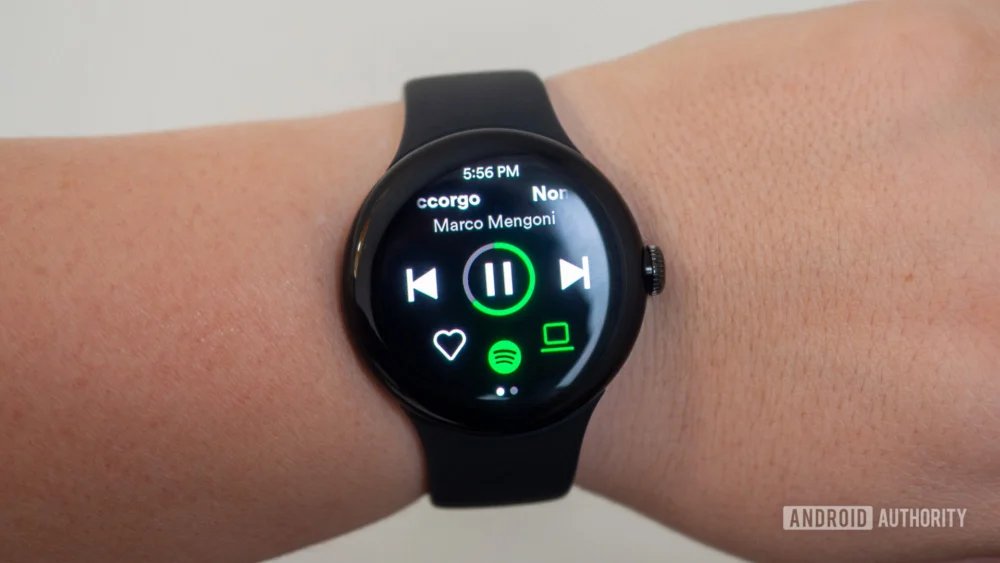
The landscape of wearable technology is defined by a constant struggle between functionality and screen real estate. As smartwatches become more powerful, developers are tasked with creating interfaces that provide comprehensive control without cluttering the miniature displays that sit upon a user’s wrist. Spotify, the world’s leading music streaming service, appears to be taking a significant leap forward in this design evolution. Recent reports indicate that the company is currently testing a radical overhaul of its "Now Playing" screen for the Wear OS platform, signaling a shift toward a more visual, gesture-heavy user experience that prioritizes aesthetics and ease of use over traditional button-based navigation.
The discovery of this new interface was first brought to light by a Telegram user operating under the handle @Fitzingout, who observed the changes while using Spotify version v9.1.20.1442. The update was spotted on a Samsung Galaxy Watch 7, a flagship device running the latest One UI 6 Watch (based on Wear OS 5). This particular hardware-software combination represents the cutting edge of the Android wearable ecosystem, making it the ideal testing ground for Spotify’s most ambitious interface experiments. The core of the redesign lies in its minimalism; the new "Now Playing" screen is dominated almost entirely by high-resolution album art, stripping away the familiar play, pause, and skip buttons that have been staples of the application since its inception on the wrist.
In this experimental layout, the song’s title and the artist’s name remain visible, providing essential context, but the primary interaction model has shifted from visual icons to intuitive gestures. According to the early reports and accompanying screen recordings, users can now tap the center of the display to toggle between playing and pausing their music. Navigation between tracks has also been streamlined: a quick double-tap on the right side of the watch face advances to the next song, while a double-tap on the left side returns to the previous track. This approach mirrors the touch controls found on many modern wireless earbuds, creating a cohesive interaction language across the Spotify hardware and software ecosystem.
However, Spotify is not abandoning the traditional control set entirely. Recognizing that some users prefer the precision of on-screen buttons—or may need access to more advanced features like shuffle, repeat, or device switching—the developers have implemented a layered architecture. The gesture-based, art-forward screen acts as the primary "hero" view. To access the standard suite of playback controls, users simply need to swipe up from the bottom of the display. This dual-layered approach suggests that Spotify is attempting to satisfy two different types of users: those who want their watch to act as a beautiful, passive display of what they are listening to, and those who require active, granular control over their queue.
This move toward a more "glanceable" UI is not happening in a vacuum. It is part of a broader, more aggressive feature rollout strategy that Spotify has maintained throughout the current calendar year. Recently, the platform introduced "Page Match," a feature designed to enhance discovery, and "About the Song," which provides deep-dive metadata and background information on tracks to enrich the listening experience. By bringing a more polished UI to Wear OS, Spotify is ensuring that its wearable application is no longer just a utilitarian remote control for a smartphone, but a premium standalone experience that justifies the high-end hardware of devices like the Pixel Watch 3 and the Galaxy Watch Ultra.
The timing of this test is particularly noteworthy given the resurgence of the Wear OS platform. For years, Android-compatible smartwatches struggled with inconsistent performance and a lack of developer interest. That narrative shifted dramatically following the partnership between Google and Samsung, which resulted in a unified platform that has attracted significant investment from major app developers. As the hardware has improved—boasting faster processors like the Exynos W1000 and more vibrant, energy-efficient AMOLED displays—the "canvas" available to designers has expanded. Spotify’s decision to emphasize album art is a direct response to these hardware improvements; on a modern smartwatch, high-contrast imagery looks stunning and provides a more premium feel than a grey-scale list of buttons.
From a user experience (UX) perspective, the shift to gestures addresses one of the most persistent complaints regarding smartwatch apps: the "fat finger" problem. On a circular screen that measures less than two inches in diameter, hitting a small "next track" icon can be difficult, especially while running, cycling, or commuting. Gestures like double-tapping the sides of the screen provide a much larger target area, reducing the cognitive load required to interact with the device. This focus on ergonomics suggests that Spotify is paying closer attention to the actual use cases of wearable technology, where interactions are usually measured in seconds rather than minutes.
Despite the excitement surrounding the leak, it appears that the new "Now Playing" screen is currently part of a limited server-side test. This is a common practice for large-scale software companies like Spotify, allowing them to gather data on user engagement and stability before committing to a global rollout. Even users who have installed the specific version (v9.1.20.1442) may not see the changes if their account has not been flagged for the trial. This cautious approach ensures that any bugs—such as gesture misfires or layout breaks on different screen shapes—can be ironed out in a controlled environment.
Furthermore, this redesign reflects a growing trend in the streaming industry toward "aesthetic consumption." In an era where music is digital and intangible, the visual representation of an album—the cover art—serves as a vital emotional link between the listener and the creator. By making the art the centerpiece of the wearable experience, Spotify is leaning into the "vinyl-ification" of digital music, where the visual identity of an era or an artist is given as much weight as the audio itself. It transforms the smartwatch from a mere tool into a piece of digital jewelry that reflects the user’s current mood and taste.
As we look toward the future of the Spotify app on Wear OS, several questions remain. It is unclear if these gesture controls will be customizable or if they will eventually integrate with the haptic feedback systems found in premium watches to provide a more tactile response. There is also the question of how this UI will adapt to podcasts and audiobooks, which are increasingly central to Spotify’s business model. Podcasts, for instance, often require "skip forward 30 seconds" buttons rather than "next track" buttons; how Spotify integrates these disparate needs into a unified, minimalist gesture system will be a key challenge for their design team.
In the broader context of the "streaming wars," Spotify’s focus on the wearable experience provides a competitive edge over rivals like Apple Music and YouTube Music. While Apple has long maintained a highly polished interface for the Apple Watch, the Android ecosystem has historically been more fragmented. By delivering a "bold new look" that rivals or even exceeds the visual flair of watchOS, Spotify is reinforcing its position as the default choice for platform-agnostic audiophiles.
The evolution of the Spotify Wear OS app from a basic playback tether to a sophisticated, gesture-driven media hub is a testament to the maturity of the wearable market. As users wait for the official announcement and wider release of this interface, the leaked footage provides a tantalizing glimpse into a future where our devices are less about clicking buttons and more about intuitive, fluid interaction. For now, the Galaxy Watch 7 owners lucky enough to be part of the test are getting a first-hand look at how Spotify intends to dominate the most personal screen we own: the one on our wrists. As the rollout continues, it will likely set a new standard for how media applications should behave in the increasingly crowded and competitive world of wearable technology.
