

Updated on September 26, 2025
The landscape of embedded systems and media devices powered by Amlogic chipsets is populated by a vast array of hardware, from sophisticated Android TV boxes to specialized industrial controllers. When these devices encounter catastrophic software failure—a condition often termed "bricking"—the standard Over-The-Air (OTA) update mechanisms become entirely inaccessible. In these critical recovery scenarios, specialized low-level tools are required to reintroduce essential system software. Central to this revival process is the Amlogic BootCard Maker for Windows, a compact yet profoundly important utility engineered specifically for the creation of bootable Secure Digital (SD) media cards capable of manually flashing core firmware onto Amlogic-based hardware.
This Windows application operates at a fundamental level, bypassing the operating system environment of the malfunctioning device to inject recovery firmware directly via the SD card slot, a method that often remains functional even when primary boot mechanisms have failed. Its significance lies in its ability to provide a lifeline for hardware that would otherwise be rendered permanently inoperable, transforming a non-responsive piece of electronics into a potentially salvageable unit.
Deep Dive into Core Functionality and Necessity
The necessity for tools like Amlogic BootCard Maker arises from the complexity of System-on-Chip (SoC) boot processes. Amlogic chipsets, like many others in the embedded space, rely on a sequence of bootloaders stored in internal, non-volatile memory. If the primary storage partition holding the main operating system becomes corrupted, or if a bad update damages the initial boot sequence, the device cannot initiate its normal software stack, rendering it unresponsive to conventional software intervention.
The BootCard Maker addresses this by meticulously preparing an external storage medium—the SD card—to act as the initial execution environment. By formatting the card correctly and writing the appropriate firmware image, the device’s hardware initialization sequence can be tricked or configured to load code from the SD card first, thereby allowing the reinstallation of the entire operating system or, more precisely, the core bootloader components that govern subsequent system startup.
Comprehensive Feature Set for Robust Recovery
Amlogic BootCard Maker consolidates several necessary technical steps into a streamlined workflow, making advanced recovery procedures accessible to a broader audience than just expert technicians. The utility’s design emphasizes efficiency and correctness in preparing the recovery media.
Precise Firmware Image Deployment
The cornerstone of the tool is its capability to accurately transfer Amlogic firmware images onto the SD card, rendering it bootable. These images are not simple data files; they contain precisely structured binary data representing the bootloader, kernel, and sometimes the initial root file system required to bring the device back to a minimal operational state. Successfully writing this image ensures that when the compromised device powers on, it reads valid, executable code from the SD card, initiating the recovery protocol mandated by the firmware structure. This feature is indispensable for recovering devices that have suffered from failed updates, improper rooting procedures, or accidental erasure of critical partitions.
Intuitive Graphical User Interface (GUI)
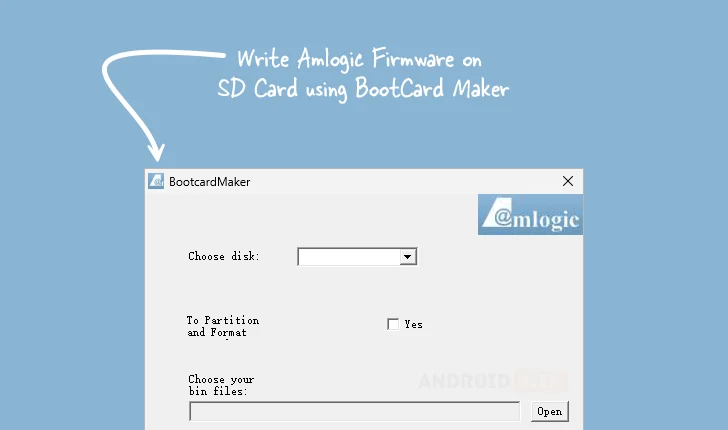
Recognizing that firmware flashing is inherently a technical procedure prone to user error, the developers have prioritized a graphical interface. This abstraction layer shields the user from complex command-line operations or raw sector manipulation. Users are guided through a clear, step-by-step process: selecting the target SD card from a list of detected drives, specifying the location of the firmware file, and initiating the process. This user-centric design democratizes the recovery process, allowing less experienced users to attempt complex hardware restoration with a significantly reduced margin for error compared to manual partitioning tools.

Automated Partitioning and Formatting Protocol
A critical, often overlooked aspect of creating bootable media is the underlying structure of the storage device. Amlogic systems often demand specific partition layouts, cluster sizes, and file system types (frequently FAT32 or specific raw partitions) to recognize the media as a valid source for boot code. Amlogic BootCard Maker automates this crucial preparation phase. It intelligently partitions and formats the SD card according to the requirements of the Amlogic hardware architecture, ensuring the card is not merely written to, but structurally configured for successful device recognition and subsequent flashing operations. This automation minimizes potential read errors stemming from incorrect formatting standards.
Broad Compatibility with .bin Firmware Files
Flexibility in firmware sourcing is paramount in hardware repair, as different regions or hardware revisions may utilize slightly different image formats. The BootCard Maker explicitly supports standard binary image files (conventionally ending in .bin). These files frequently encapsulate the core bootloader binary, which is often the first component an Amlogic device attempts to load. By accepting these common binary formats, the utility ensures compatibility with a wide spectrum of readily available recovery images provided by hardware manufacturers or community developers, granting users flexibility in sourcing the exact files needed for their specific hardware model.
True Portability: Zero Installation Footprint
The application is designed as a portable executable. This means it requires no formal installation procedure, registry entries, or reliance on bundled system dependencies. Users can execute the utility directly from a downloaded archive or a USB drive. This portability is highly valued by hardware repair technicians who may service multiple workstations or need to perform emergency repairs on systems where administrative privileges for software installation are restricted or unavailable. It ensures the tool is always ready for immediate deployment regardless of the host machine’s configuration.
SD Card as a Primary Recovery Vector (Alternative to USB Burning)
While Amlogic devices frequently support recovery via USB connection using specialized tools like the Amlogic USB Burning Tool, this pathway is contingent upon the device’s USB controller and initial bootloader functionality being intact enough to enumerate a connection to a host PC. In severe bricking scenarios, the USB stack itself might be compromised. The BootCard Maker offers an essential fallback mechanism: SD card booting. This method leverages a different, often more resilient, hardware pathway for initial code execution. If USB communication fails, preparing a bootable SD card provides an independent, parallel route for system restoration, dramatically increasing the probability of a successful recovery when standard USB flashing proves impossible.
Availability and Version Control
The continued development and distribution of such niche tools are crucial for the longevity of the hardware they support. The Amlogic BootCard Maker is made available to the community to facilitate ongoing maintenance and repair activities. The current release detailed is Version 1.01, indicating a level of refinement from an initial launch version.
The utility is offered for the Windows operating system, supporting both 32-bit and 64-bit architectures, ensuring broad compatibility across modern and slightly older technician workstations.
Distribution Matrix for Amlogic BootCard Maker v1.01:
| Version | Download Link |
|---|---|
| 1.01 | Link (Direct Download Host) |
The provision of direct, dedicated download links underscores the utility’s role as an essential, standalone tool within the hardware maintenance ecosystem. For users encountering difficulties with the standard recovery channels, the Amlogic BootCard Maker represents a specialized, powerful, and accessible method to manually intervene at the lowest level of system software, safeguarding investments in Amlogic-powered electronics against irreversible software failure. Its combination of low-level access, automated preparation, and portability establishes it as a cornerstone utility for troubleshooting these complex embedded systems.
