

Updated on September 26, 2025.
A specialized, lightweight Windows application known as Amlogic BootCard Maker has surfaced as a critical instrument for technicians and advanced users engaged in the low-level maintenance of hardware integrated with Amlogic chipsets. This utility is meticulously engineered to facilitate the creation of fully bootable Secure Digital (SD) cards, a process indispensable for manually injecting firmware onto embedded systems. Its prominence stems largely from its capacity to intervene when conventional Over-The-Air (OTA) updates falter or when devices encounter catastrophic software failures, often resulting in a "bricked" state where standard operating system access is impossible. The ability to bypass standard software pathways by utilizing a prepared boot medium underscores the strategic importance of this tool in hardware revitalization efforts.
The core mission of the Amlogic BootCard Maker revolves around circumventing software blockades to restore the foundational operating environment of Amlogic-based electronics, which span a vast ecosystem including media players, single-board computers, and various set-top boxes. When a device’s primary storage or bootloader becomes corrupted, rendering it unresponsive to typical flashing procedures, the BootCard Maker provides a robust, hardware-level alternative using removable media.
Comprehensive Feature Set Tailored for System Restoration
The application is not merely a simple writing utility; it incorporates several key functionalities designed to streamline and secure the complex process of firmware deployment onto Amlogic hardware. Each feature is architecturally significant, contributing to a higher success rate in device recovery scenarios.
Creation of Self-Contained Bootable Firmware Images
The primary function involves encapsulating necessary Amlogic firmware packages—often consisting of bootloader components, kernel images, and root file systems—into a structure that an Amlogic device’s secondary boot mechanism can recognize and execute from an SD card. This process transforms a standard SD card into a portable recovery environment. By preparing this bootable infrastructure, users gain the power to overwrite or repair corrupted partitions directly, effectively reinstalling the operating system from a known-good state. This capability is crucial for maintaining the longevity and functionality of hardware facing obsolescence or accidental corruption.
Intuitive Graphical Interface for Enhanced Accessibility
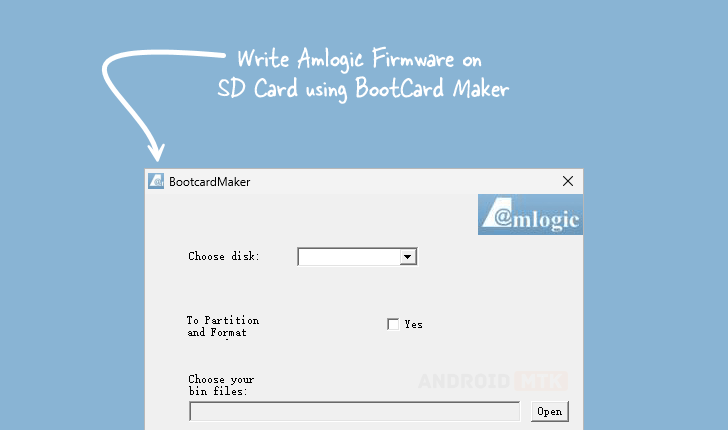
Recognizing that low-level flashing operations are inherently technical, Amlogic BootCard Maker employs a clean, graphical user interface (GUI). This design philosophy significantly lowers the barrier to entry for users who may lack extensive command-line proficiency. The interface abstracts away much of the underlying complexity, guiding the user through sequential steps: selection of the target storage medium (the SD card), specification of the device partitions, the formatting procedure, and finally, the selection of the appropriate firmware image file. This systematic approach minimizes user error, a common pitfall in manual recovery operations where a single misplaced parameter can lead to further complications.
Automated Partitioning and Formatting Protocols
A critical, often overlooked aspect of successful flashing is the preparation of the target storage medium. Amlogic BootCard Maker automates the necessary steps to ensure the SD card adheres to the specific partitioning schemes required by Amlogic System-on-Chips (SoCs). The tool automatically handles the creation of necessary partitions and their subsequent formatting using file systems compatible with the Amlogic boot sequence. By enforcing this correct structure prior to writing the firmware binaries, the utility drastically reduces the probability of boot failures stemming from incompatible disk geometry or filesystem corruption on the recovery media itself. This automated standardization ensures optimal communication between the hardware and the loaded firmware during the critical initial boot sequence.
Broad Compatibility with Standard Binary Firmware Files
The utility demonstrates flexibility by natively supporting the industry-standard .bin file format for firmware images. This format frequently encompasses the low-level bootloader code and initial system images required for device initialization. Support for these raw binary files is essential, as manufacturers and third-party developers often distribute recovery files in this precise, uncompressed format. This compatibility ensures that users are not restricted to proprietary packaging formats, allowing them to leverage a wider array of publicly available or custom-compiled firmware resources for their specific Amlogic models.

Portability and Zero-Installation Deployment
In a professional or multi-device environment, operational agility is paramount. Amlogic BootCard Maker functions as a truly portable application. This means it requires no formal installation procedure on the host Windows machine; it executes directly from its downloaded package. This characteristic offers significant advantages: it conserves system resources, avoids potential conflicts with registry entries or system libraries, and allows technicians to carry the tool easily across different workstations or laptops without needing administrative rights for installation, enhancing workflow efficiency across varied computing environments.
A Strategic Alternative to USB-Based Recovery Methods
While Amlogic devices frequently support recovery via the Amlogic USB Burning Tool, this method relies on the device’s USB hardware and the bootloader’s ability to enter a recognized USB mode (often referred to as "maskrom" or "loader" mode). However, in cases where the USB interface itself is damaged, or the firmware corruption is so severe that the device cannot initialize the USB stack, the USB method becomes non-viable. BootCard Maker offers a vital fallback mechanism. By utilizing the SD card slot—a component often initialized earlier or managed differently by the boot ROM—the tool bypasses potential USB communication failures, significantly increasing the overall probability of a successful hardware salvage operation.
Operational Context and Technical Necessity
The continued relevance of the Amlogic BootCard Maker is intrinsically linked to the widespread adoption of Amlogic SoCs in consumer electronics. These chips power numerous Android TV boxes, smart displays, and embedded industrial controllers. As these devices age or are subjected to unofficial software modifications, the risk of irreversible software failure escalates.
Recovery procedures involving SD cards are often considered a lower-level intervention than USB flashing because the initial boot process on many Amlogic platforms prioritizes reading the boot sequence from external storage (like an SD card) before engaging complex peripheral interfaces. Successfully booting from a prepared SD card allows the system to load a minimal environment capable of rewriting the internal eMMC or NAND storage, which is the ultimate goal of the recovery process.
The utility’s role is therefore critical in the lifecycle management of these hardware platforms, moving beyond simple software updates to genuine hardware resuscitation. For developers and hobbyists dealing with open-source firmware ports or hardware experimentation, having a reliable SD card creation tool is non-negotiable, as it provides a rapid means to revert experimental builds that fail to boot.
Accessing the Recovery Utility
The distribution of Amlogic BootCard Maker is made straightforward to ensure rapid deployment when crisis strikes. The application is provided for the Windows operating system, accommodating both 32-bit and 64-bit architectures, ensuring compatibility across a broad spectrum of modern and legacy maintenance machines.
The availability of version 1.01 is currently highlighted, indicating a stable, established iteration of the software. Users seeking to acquire this essential diagnostic and recovery utility can utilize the provided official download link structured for accessibility:
| Version | Download |
|---|---|
| 1.01 | [Link] (Referring to the specific host URL provided for direct download) |
The commitment to providing this utility as a direct download rather than through complex package managers reflects an understanding of emergency technical requirements, where immediate access to the tool is paramount for minimizing device downtime. The ongoing support and updates, as evidenced by the revision date of September 26, 2025, suggest that the tool remains actively maintained to support evolving Amlogic hardware platforms and emerging firmware standards. The BootCard Maker stands as a testament to the community and developer commitment to maintaining the viability of hardware long after initial manufacturer support wanes.