

Updated on September 26, 2025
The Amlogic BootCard Maker has surfaced as a specialized, compact Windows utility engineered specifically for the creation of bootable Secure Digital (SD) cards. Its core competency lies in facilitating the manual flashing of firmware onto electronic devices powered by Amlogic chipsets. This tool is particularly invaluable in critical recovery scenarios where conventional Over-The-Air (OTA) update mechanisms have encountered insurmountable errors, or when hardware has been rendered inoperable—commonly referred to as being "bricked." In the ecosystem of embedded systems, media players, and single-board computers utilizing Amlogic System-on-Chips (SoCs), the ability to bypass standard software channels for low-level flashing is often the last recourse for hardware revitalization.
The utility’s architecture is designed for direct operation, eliminating the need for complex installation procedures. As a portable application, it can be executed directly from its downloaded state on any compatible Windows machine (both 32-bit and 64-bit architectures are supported). This portability offers significant logistical advantages, especially for field technicians or developers who frequently move between different workstations and require immediate access to firmware recovery tools without consuming local storage or navigating complicated setup routines.
Deep Dive into Core Functionality and Feature Set
The Amlogic BootCard Maker is not merely a simple file copier; it integrates several procedural steps necessary for establishing a correctly structured, bootable medium. This methodical approach ensures that the resulting SD card is recognized by the target Amlogic hardware as a legitimate source for system initialization or recovery.
Precision in Firmware Image Preparation
The utility’s foundational feature involves the meticulous preparation of the SD card to host the Amlogic firmware payload. It constructs a bootable environment on the storage medium, effectively transforming a standard SD card into a recovery flash drive. This process is crucial for devices whose internal storage or primary boot mechanisms are corrupted. By initiating the boot sequence from the prepared SD card, the device’s low-level bootloader gains access to the necessary files to rewrite or repair the system partitions, thereby restoring the operating system’s integrity. This capability positions the BootCard Maker as a fundamental instrument for maintaining the lifecycle of Amlogic-based products.
Emphasis on Accessibility through Graphical Interface
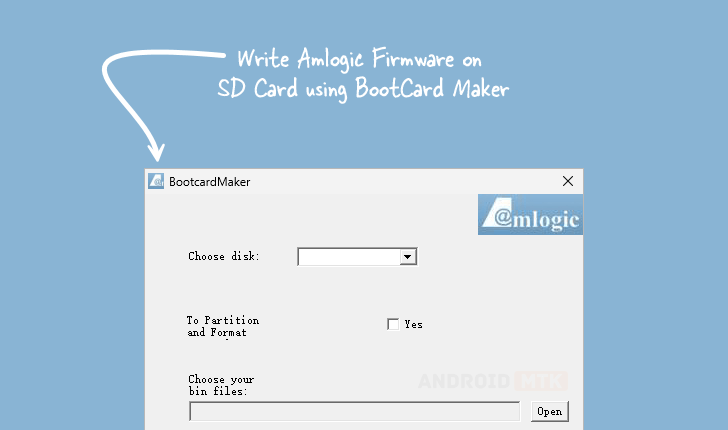
Recognizing that firmware flashing is inherently a technical undertaking often associated with command-line interfaces and complex parameter setting, the Amlogic BootCard Maker distinguishes itself with a straightforward Graphical User Interface (GUI). This design philosophy lowers the barrier to entry for less experienced users. The interface streamlines the complex process of drive identification, partition selection, formatting routines, and the crucial selection of the appropriate firmware image file. By visualizing these steps, the risk of user error—such as selecting the wrong target drive or inputting incorrect parameters—is substantially mitigated, promoting a higher success rate in recovery operations.

Automated Partitioning and Formatting Protocols
A critical, yet often invisible, aspect of successful low-level flashing involves ensuring the target storage medium adheres to the specific partitioning scheme required by the Amlogic bootloader. The BootCard Maker automates this prerequisite step. It possesses the intelligence to correctly partition and format the SD card prior to writing the firmware data. For Amlogic chipsets, this often means creating specific primary and secondary partitions formatted with file systems recognizable during the initial boot stages. By managing this formatting automatically, the tool guarantees structural compatibility, significantly reducing the likelihood of boot failures attributed to incorrectly prepared media.
Broad Compatibility with Standard .bin Firmware Files
The utility exhibits robust support for the most common format utilized in Amlogic system recovery: the .bin file extension. These files often encapsulate the bootloader binaries, kernel images, or complete system images. The ability to process these standard binary blobs provides users with maximum flexibility, allowing them to utilize firmware packages sourced from various manufacturers or community developers, provided they adhere to the recognized Amlogic structure. This compatibility ensures the tool remains relevant across a broad spectrum of Amlogic hardware revisions and software versions.
The Advantage of Application Portability
The "no installation required" attribute solidifies the tool’s utility in professional environments. Being a portable executable means the application carries all its necessary libraries and dependencies within its own package. This characteristic is highly valued in scenarios involving multiple repair stations or when time is of the essence. Technicians can carry the tool on a USB drive and deploy it instantly, ensuring consistency in the recovery process regardless of the host computer’s configuration or installed software base.
Strategic Alternative to USB Flashing Methods
Perhaps one of the most compelling aspects of the Amlogic BootCard Maker is its function as a viable, and sometimes superior, alternative to the widely used Amlogic USB Burning Tool. While USB flashing is a powerful method, it relies on the device’s USB boot capabilities being functional and correctly recognized by the host PC’s drivers. In deeply corrupted states, or on devices where the USB interface itself is compromised or improperly initialized by the bootloader, USB flashing becomes impossible. The BootCard Maker leverages the SD card slot, which is often initialized at a lower and more resilient stage of the boot sequence. This SD card pathway provides a necessary contingency plan, dramatically increasing the probability of reviving devices that are unresponsive to USB-based recovery attempts. It circumvents potential driver conflicts or hardware initialization failures associated with the USB protocol during the pre-OS loading phase.
Implementation and Accessibility
The release of Amlogic BootCard Maker version 1.01 signifies a stable, ready-to-deploy iteration of this specialized software. The availability of direct download links underscores the community and professional need for accessible firmware repair utilities.
| Version | Download |
|---|---|
| 1.01 | Link (Rel=noopener Target=_blank Title=BootCard Maker v1.01) |
The commitment to providing this tool through direct hosting links ensures that users can quickly obtain the necessary software without navigating potentially confusing or outdated repository sites. The designation of version 1.01 suggests that initial testing and refinement have been incorporated, presenting a reliable platform for immediate use in hardware recovery operations across various Amlogic-powered platforms. The enduring relevance of Amlogic SoCs in consumer electronics, from Android TV boxes to specialized embedded systems, ensures that tools like the BootCard Maker will remain vital components in the diagnostic and repair toolkits of hardware enthusiasts and service professionals alike. The utility’s focused scope—creating recovery media via SD card—fills a critical niche that more generalized flashing tools often overlook or treat as a secondary function.