

Updated on September 26, 2025.
The realm of embedded systems, particularly devices powered by Amlogic chipsets—ubiquitous in Android TV boxes, single-board computers, and media players—often necessitates direct, low-level intervention when standard software updates fail. Addressing this critical need is the Amlogic BootCard Maker, a specialized, compact Windows application engineered specifically to facilitate the creation of bootable Secure Digital (SD) cards. This utility transcends typical software management tools, positioning itself as a crucial lifeline for technicians and advanced users facing severe device malfunctions, such as hard bricks or corrupted operating system installations where Over-The-Air (OTA) update mechanisms have become inaccessible.
The core mission of the Amlogic BootCard Maker revolves around the manual preparation and deployment of essential firmware images directly onto removable storage media. Unlike standard operating system installations, this process bypasses much of the higher-level boot sequence checks, allowing users to inject foundational bootloader code or complete system images directly into the hardware’s memory structure via the SD card slot. This capability is paramount in recovery scenarios where the device’s internal storage or recovery partition integrity has been compromised beyond the point of software recognition.
The application’s architecture is deliberately focused, eschewing feature bloat in favor of robust execution of its primary function: generating a reliably bootable carrier for Amlogic system software. This targeted approach ensures efficiency and minimizes potential points of failure during the sensitive recovery procedure.
Comprehensive Feature Set Underpins Recovery Efficacy
The utility’s effectiveness is derived from several integrated features, each contributing to a streamlined, albeit technical, recovery workflow. These functions collectively transform a standard SD card into a specialized diagnostic and flashing medium tailored for Amlogic hardware environments.
Precision Firmware Image Integration for Bootability
At the heart of the BootCard Maker lies its ability to accurately ingest and write Amlogic firmware packages onto the target SD card, rendering the card inherently bootable. This is not a simple file copy operation; the software manages the complex sector arrangement and partition table structures required for the Amlogic hardware to recognize the card as a valid boot source. By correctly embedding the necessary bootloader sequences—often contained within specific binary files—the tool enables the initial stages of hardware initialization to proceed from the external medium, effectively bypassing the corrupted internal storage environment. This feature is the cornerstone for bringing ‘bricked’ devices back to a recognizable state, allowing for subsequent, more permanent internal flashing procedures.
Intuitive Graphical Interface for Technical Procedures
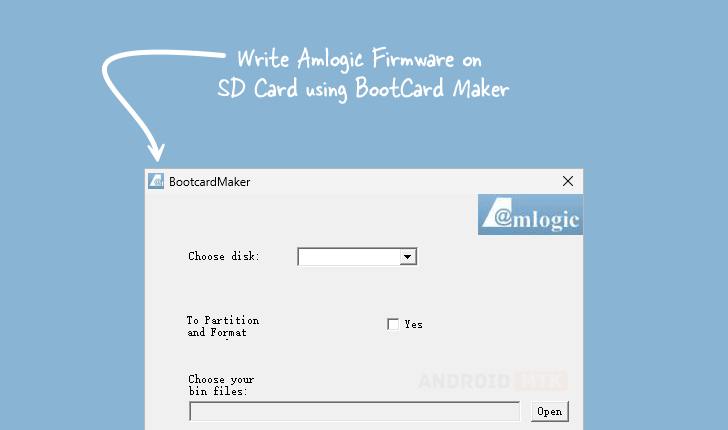
While the underlying task of flashing firmware is technically demanding, involving precise knowledge of hardware addressing and boot sectors, the Amlogic BootCard Maker employs a graphical user interface (GUI) designed to lower the barrier to entry. This user-friendliness is crucial in high-stress recovery situations. The interface simplifies the complex steps of drive identification, partition mapping, media formatting, and firmware file selection into easily navigable steps. This abstraction allows users who may not possess deep command-line expertise to execute precise flashing operations, significantly broadening the accessibility of low-level device repair. The visual confirmation of selected drives and chosen firmware files reduces the potential for costly operational errors associated with manual command-line entry.

Automated Partitioning and Formatting Protocols
A critical aspect often overlooked in manual recovery attempts is the precise formatting and partitioning of the storage medium. Amlogic systems often demand specific partition layouts, file system types (such as FAT32 or specific raw block formats), and boot flags set correctly on the SD card. The BootCard Maker automates this entire preparatory sequence. Before writing the firmware payload, the tool intelligently partitions and formats the SD card according to the established best practices for Amlogic boot processes. This automation ensures structural compatibility between the recovery medium and the target device’s boot ROM, substantially mitigating errors that commonly arise from improperly formatted cards, thereby enhancing the reliability of the initial boot attempt.
Broad Support for Standardized Binary Firmware Files
Flexibility in firmware sourcing is vital in the diverse ecosystem of Amlogic devices. The utility is engineered to natively support standard .bin firmware files. These files often encapsulate the core bootloader binary or specialized low-level initialization code. By focusing on this standardized format, the BootCard Maker ensures compatibility across a wide array of Amlogic SoCs and device manufacturers. This support allows users to leverage widely available official firmware releases or community-developed recovery images that adhere to the binary format convention, offering substantial flexibility when specific, device-manufacturer-provided tools are unavailable or incompatible.
Portability Enhances Field Service Efficiency
The Amlogic BootCard Maker is distributed as a portable application, meaning it requires no formal installation process on the host Windows machine. This characteristic confers significant operational advantages, particularly for technical professionals or service centers managing multiple repair stations. The utility can be instantly launched from removable media (like a USB drive) on virtually any Windows PC (32-bit or 64-bit), conserving system resources and eliminating the need for administrative privileges often required for installing low-level disk manipulation software. This portability ensures that the recovery tool is always immediately accessible, regardless of the host computer’s configuration.
A Vital Alternative to USB Burning Tools
In the ecosystem of Amlogic repair, the Amlogic USB Burning Tool is perhaps the most recognized method for firmware recovery. However, this method relies entirely on the device’s USB On-The-Go (OTG) functionality being operational and recognized by the host PC, which is frequently the exact function that fails when a device is severely bricked. The BootCard Maker serves as a crucial fallback mechanism. By utilizing the SD card slot—which often initializes earlier in the hardware boot sequence than the USB controller initialization—the utility provides an independent pathway for firmware introduction. This redundancy ensures that recovery efforts can proceed even when the device cannot establish a functional USB connection to a host computer, significantly increasing the probability of salvaging compromised hardware.
Accessibility and Distribution of the Utility
Recognizing the urgent nature of hardware recovery, the developers have made the Amlogic BootCard Maker readily available for download. The utility is offered as a standalone package compatible with both 32-bit and 64-bit versions of the Windows operating system, maximizing its usability across various technician workstations.
The current iteration, Version 1.01, is provided via dedicated hosting links, ensuring direct and reliable access to the executable software package.
| Version | Download |
|---|---|
| 1.01 | [Link] (Direct link provided via external host) |
The availability of a stable, portable tool specifically tailored for SD card booting solidifies its position as an indispensable component in the Amlogic hardware maintenance toolkit. While the procedure remains technical, the application’s design focuses on making the execution phase as straightforward and reliable as possible, thereby empowering users to effectively manage critical firmware recovery situations without being entirely dependent on USB-based flashing protocols. The continued relevance of this utility underscores the ongoing need for direct, low-level access methods in maintaining the longevity and operability of modern digital media and embedded computing devices relying on Amlogic architecture.