

The digital landscape has undergone a seismic shift in a remarkably short period. It was only in 2022 that the internet was captivated and slightly unsettled by a primitive AI-generated video of actor Will Smith consuming noodles—a surreal display that now feels like a relic of a distant era. Today, artificial intelligence has transcended the realm of novelty to become the foundational infrastructure of modern computing. However, as tech giants like Google and Microsoft race to embed these capabilities into the palm of every hand, a growing friction has emerged between corporate ambition and user autonomy. The primary flashpoint for this tension on the Android platform is a background service known as AICore, an application that has begun appearing on devices without explicit user invitation, sparking a debate over whether this "silent" innovation is a benefit or a burden.
For years, the promise of the smartphone was one of modularity and choice. Users expected to be the arbiters of what occupied their device’s storage and processing power. Yet, the recent deployment of AICore represents a departure from this philosophy. Google, alongside partners like Samsung, has begun a stealthy rollout of this system-level application, often installing it via background updates. This move has left many enthusiasts and privacy-conscious users asking a fundamental question: In the rush to make every device "smart," have the manufacturers forgotten to ask for permission?

To understand why this app is causing a stir, one must first understand its function. AICore is not a traditional app with a user interface; rather, it is a sophisticated background framework designed to facilitate on-device machine learning. Its primary purpose is to host and manage the Large Language Models (LLMs) that power the next generation of mobile features. By running these models locally, Google aims to provide faster, more secure AI interactions that do not require a constant round-trip to a remote server. This is the engine room for "Gemini Nano," Google’s most efficient model built for mobile tasks.
The list of features tethered to AICore is extensive and continues to grow. For owners of Google Pixel devices, the app is the backbone for Pixel Studio’s creative tools, the highly touted Pixel Screenshots organization system, and the Phone app’s Call Notes, which provides automated summaries of conversations. It also powers Magic Compose within Google Messages, offering context-aware suggestions for replies, and the Summarize feature in the Recorder app. On the Samsung Galaxy side, while the branding may differ under the "Galaxy AI" umbrella, many of the core generative features rely on this same underlying AICore architecture to function effectively.
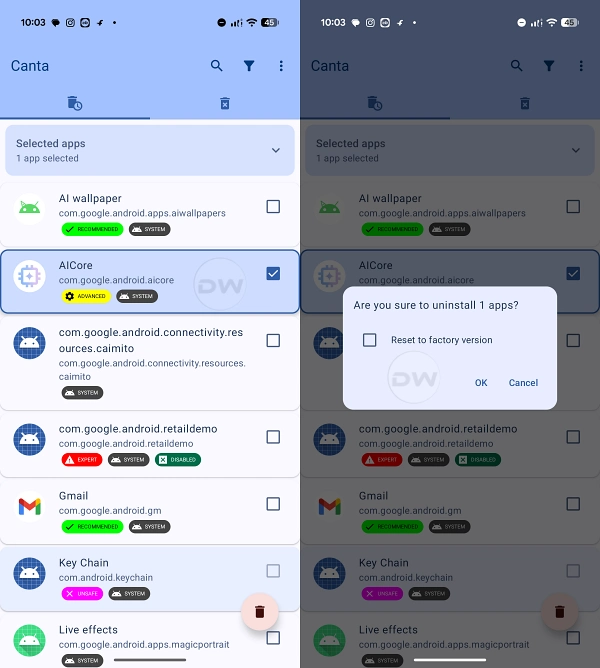
Despite these functional advantages, the "forced" nature of the installation has drawn significant criticism. Unlike a standard application downloaded from the Play Store, AICore is treated as a system component. This status grants it deep permissions and, more controversially, makes it nearly impossible for the average user to remove. For the majority of consumers, the "Uninstall" button is simply non-existent, replaced by a "Disable" option that stops the service but leaves the data intact. Completely purging the app typically requires technical workarounds, such as using Android Debug Bridge (ADB) commands or third-party tools like Canta, which are beyond the comfort zone of most casual users.

The primary grievance cited by those seeking to remove AICore is its massive digital footprint. In an era where high-resolution photography and 4K video already strain device capacities, AICore is a storage glutton. Because it must house the actual weights and parameters of AI models to function offline, the app frequently occupies between 5 and 7 gigabytes of internal storage. For users with 128GB devices, this represents a significant portion of their available space, sacrificed for features they may never use. Beyond storage, there are mounting reports regarding the impact on hardware longevity and daily performance. Users who have successfully uninstalled or disabled the service often report a noticeable "uptick" in battery life and a decrease in background heat generation. By eliminating the constant model updates and background indexing that AICore performs, these users have reclaimed several percentage points of "screen-on-time," suggesting that the cost of "intelligence" is paid in battery cycles.
However, the decision to remove AICore is not without its complications, particularly regarding privacy and functionality. There is a profound irony in the privacy debate surrounding this app. While users may resent its forced presence, the very existence of AICore is a privacy-focused initiative. By processing data locally on the device’s NPU (Neural Processing Unit), AICore ensures that sensitive information—such as the contents of your messages or the audio of your voice recordings—never has to leave the device. When a user uninstalls AICore, they do not necessarily disable the AI features themselves; instead, they often force the device to route those requests to the cloud. This shift moves the processing from a private, local environment to a corporate server, potentially increasing the data trail left by the user.
Furthermore, removing the app can lead to a fragmented user experience. On Samsung devices, for instance, attempting to use generative tools like "Sketch to Image" or "Text Summaries" without the local framework active will trigger prompts to disable "Process data only on device" settings. The device essentially warns the user that since the local brain is missing, the phone must now rely on external servers to think. In some cases, specific features may simply break or refuse to launch, leading to system instability in apps that expect the AICore API to be present.

For those determined to reclaim their storage and battery life, the path forward involves a choice between disabling and uninstallation. Disabling the app is the "safe" route; it prevents the app from running in the background and consuming CPU cycles, but it does not free up the 5-7GB of storage space. This can be done through the standard Settings menu under the "Apps" section, though one must often toggle the "Show system apps" option to find it.
The more radical path—uninstallation—requires a deeper level of system access. Tools like Canta have gained popularity in the Android community for their ability to remove "unremovable" bloatware without requiring the user to "root" their device. By leveraging Shizuku (a tool that grants apps higher-level permissions), Canta allows users to select AICore and remove it entirely. The results are immediate: the storage is returned to the user, and the background processes cease. Should the user later decide they miss the AI-driven summaries or magic compositions, these tools typically offer a "reinstall" function to restore the system to its factory state.
Interestingly, the real-world impact of removing AICore varies significantly based on individual habits. Many users find that the features they value most are not actually dependent on this specific package. For example, "Circle to Search," one of the most popular recent additions to the Android ecosystem, often continues to function perfectly even after AICore is disabled. This suggests that Google is using a hybrid approach, where some AI features are lightweight and server-reliant, while only the most intensive generative tasks require the AICore framework. For a user who primarily uses their phone for communication, browsing, and photography, the 7GB trade-off for a "Summarize" button they never click is often a poor bargain.

Ultimately, the controversy over AICore is a microcosm of a larger struggle in the tech industry: the balance between "feature-pushing" and user consent. While Google and its partners argue that these features are essential for a modern smartphone to remain competitive, the lack of transparency in the rollout has fostered a sense of distrust. If AI is truly the future of mobile computing, it should be a future that users choose to opt into, rather than one that is silently installed in the middle of the night. Until tech behemoths provide a clear, one-tap method to manage these massive AI models, the community-driven quest to "de-bloat" devices will only continue to grow. For now, the choice remains with the user: embrace the local intelligence and the storage cost that comes with it, or take the technical leap to strip the "core" out of their AI-powered device.