

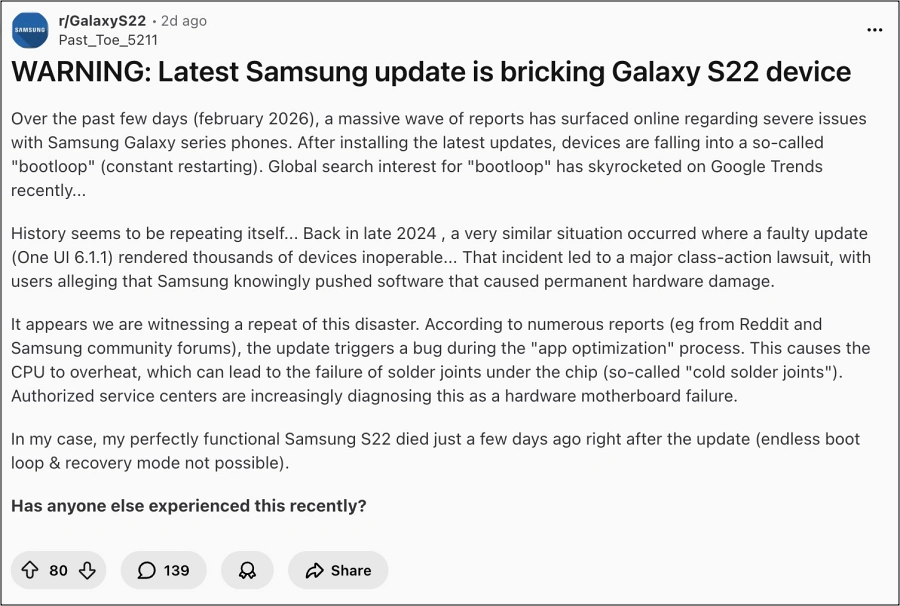
The promise of long-term software support is often a primary selling point for flagship smartphones, yet for owners of the Samsung Galaxy S22 series, the arrival of the February 2026 update has transformed a routine security maintenance cycle into a digital nightmare. Reports are flooding online forums and social media platforms indicating that the latest firmware rollout is causing catastrophic failures, ranging from infinite bootloops to complete hardware "bricking." This development has reignited a fierce debate regarding the quality assurance protocols at Samsung and whether the South Korean tech giant is inadvertently—or perhaps negligently—shortening the lifespan of its legacy hardware through unstable software deployments.
The Galaxy S22, S22+, and S22 Ultra, which launched in early 2022, are currently in the fourth year of their supported lifecycle. Under Samsung’s current commitment to providing five years of security updates, these devices are theoretically supposed to remain secure and functional until 2027. However, the February 2026 patch has proven to be a volatile exception. Almost immediately following the installation of the update, users across various regions reported that their devices failed to return to the Android operating system. Instead, many units became trapped in a "bootloop," a state where the phone repeatedly attempts to start up, only to crash at the Samsung logo and restart the cycle indefinitely. For others, the situation is even more dire, with the devices refusing to power on at all, effectively becoming expensive "bricks."

This is not an isolated incident in the history of the S22 series. Industry analysts and disgruntled consumers are pointing to a troubling pattern of behavior from Samsung’s software engineering department. Approximately eighteen months ago, the rollout of the One UI 6.1.1 update triggered a similar wave of system failures for the same hardware family. At that time, Samsung was forced to temporarily halt the update and issue emergency patches to rectify the damage. The recurrence of such a critical flaw in 2026 suggests that the lessons of the past have not been fully integrated into the company’s current development pipeline. Critics argue that as devices age, the complexity of maintaining modern software on older chipsets increases, and Samsung may be failing to allocate the necessary resources to ensure that these legacy updates are safe for public consumption.
The scope of the current crisis extends beyond mere software glitches. There are growing reports of hardware-level damage resulting from the update process. One prominent case involved a user in India whose Galaxy S22 5G suffered a total motherboard failure immediately following the February 3rd update. The user documented a sequence of events where the phone began to restart spontaneously before eventually crashing permanently. This suggests that the update may be causing thermal spikes or voltage irregularities during the installation process that the aging internal components can no longer withstand. When the user sought assistance from an authorized Samsung service center, they were met with a refusal to provide a free repair, as the device was outside its standard warranty period. This has placed many loyal customers in a precarious position: their phones were rendered inoperable by the manufacturer’s own software, yet they are being asked to pay hundreds of dollars for hardware repairs.
Furthermore, those who managed to avoid a total system crash are reporting severe regressions in battery performance and power management. Detailed accounts on platforms like Reddit describe a chaotic scenario where battery percentages fluctuate wildly. One user reported their husband’s S22 plummeted from 80% to 16% in mere minutes, only to shut down entirely shortly thereafter. Even more concerning are reports that the devices have lost the ability to draw a charge effectively. Users have noted that even when connected to official Samsung high-speed chargers, the devices remain stagnant at low percentages for hours, indicating a fundamental breakdown in the communication between the software and the battery management IC (Integrated Circuit).

The legal ramifications of these repeated failures are already beginning to take shape. Following the One UI 6.1.1 disaster, several consumer advocacy groups and individual users initiated class-action lawsuits against Samsung, alleging that the company was engaging in a form of "forced obsolescence" by pushing updates that compromised the integrity of older hardware. With the February 2026 update causing a new wave of destruction, legal experts anticipate that these existing lawsuits will be expanded or that new litigation will be filed. The core of the legal argument rests on the premise that a manufacturer has a duty of care to ensure that mandatory or highly encouraged software updates do not destroy the functionality of a product that the consumer rightfully owns.
For the millions of Galaxy S22 users who have not yet downloaded the update, the consensus among tech experts is to "wait and see." Disabling auto-updates in the developer settings has become a common recommendation to avoid the risk of a bricked device. However, for those who have already fallen victim to the update, the path to recovery is narrow and fraught with difficulty.
There are several documented workarounds that have seen varying degrees of success. The first and least invasive method is the "Force Restart." By holding down the Power key and Volume Down button simultaneously for more than 15 seconds, some users have been able to break the bootloop cycle and force the device to handshake with the OS. However, this is often a temporary fix, as the underlying corruption remains.

A more technical approach involves clearing the system’s cache partition. This requires booting the device into "Recovery Mode," a task made difficult by the bootlooping state. Users must power down the device completely—often by waiting for the battery to drain—and then connect it to a PC via a USB-C cable. By holding the Power and Volume Up buttons during the boot sequence, the user can access the stock recovery menu. From there, selecting "Wipe Cache Partition" can sometimes remove the conflicting temporary files that are preventing a successful boot. This method is preferred by many because it does not result in the loss of personal data.
If clearing the cache fails, the next step is the "Factory Data Reset." Accessible from the same Recovery Mode menu, this process wipes the device entirely, returning it to its original out-of-the-box state. While this often resolves software-level conflicts, it results in the total loss of all photos, messages, and local files. For many users, this is a devastating price to pay for a mistake made by the manufacturer.
For the most advanced users, "flashing" the original firmware via a tool called Odin is the final software-based resort. This involves downloading the official Samsung firmware files to a computer and manually overwriting the phone’s operating system. While effective, this process carries its own risks; if the connection is interrupted or the wrong firmware version is used, the device can be permanently damaged. Moreover, this method is generally only accessible to those with an unlocked bootloader or those comfortable navigating Samsung’s proprietary flashing environment.

The broader implications of this incident raise questions about the future of the smartphone industry. As companies like Samsung and Google compete to offer longer support windows—some now reaching seven years—the technical debt associated with supporting hundreds of different hardware and software combinations becomes immense. If a major manufacturer like Samsung cannot successfully update a four-year-old flagship without risking widespread hardware failure, the industry may need to reconsider its approach to legacy support. Some critics suggest that Samsung should transition to a "yearly" update model for older devices, allowing for more rigorous testing, or perhaps offer a "LTS" (Long Term Support) version of their software that prioritizes stability over new features.
As of now, Samsung has not issued a formal global recall or a public apology for the February 2026 update issues. The company’s official support channels continue to recommend standard troubleshooting steps that many users find insufficient. Until a corrected firmware version is released, the Galaxy S22 series remains in a state of crisis, and the trust between Samsung and its long-term customers continues to erode. Owners are encouraged to back up their data immediately if their devices are still functional and to exercise extreme caution before accepting any new software prompts from the manufacturer.
