

In a move that has sent shockwaves through the mobile technology industry, Motorola has officially signaled the commencement of its Android 17 beta testing phase, positioning itself at the vanguard of the next generation of mobile operating systems. Traditionally, the race to implement the latest Google software has been a two-horse sprint between Samsung and OnePlus, with other manufacturers trailing months behind. However, the landscape of software longevity and agility is currently undergoing a radical transformation. With Google having recently initiated the preliminary testing phases for the seventeenth iteration of Android—internally codenamed "Cinnamon Bun"—the industry expected the usual suspects to follow suit. Instead, Motorola has defied historical precedents by becoming one of the first original equipment manufacturers (OEMs) to open doors for the Android 17 environment.
This development is particularly striking when viewed through the lens of Motorola’s historical performance regarding software maintenance. For years, the Lenovo-owned brand has faced significant criticism from tech enthusiasts and consumer advocacy groups for what many described as a "dismal" track record of operating system upgrades. While competitors like Google and Samsung have moved toward a standard of seven years of guaranteed security and OS updates, Motorola has frequently been associated with a "one and done" philosophy. In several documented instances, certain models in the Motorola lineup received only a single year of support, and in the most egregious cases, some devices were left with zero major OS updates despite their hardware capabilities. This perceived lack of commitment to software longevity created a narrative of obsolescence that Motorola has struggled to shake off. Consequently, the announcement that they are leading the charge for Android 17 is not merely a technical update; it is a potential rebranding of their entire corporate strategy toward software lifecycle management.
The Android 17 beta program represents a significant milestone for the platform. As Google refines the core architecture of the OS, focusing on deeper integration of artificial intelligence, enhanced privacy controls, and more efficient resource management, the early involvement of OEMs is crucial. By jumping onto the "Cinnamon Bun" bandwagon ahead of its peers, Motorola is positioning its hardware to be the primary testing ground for how these new features interact with third-party skins and proprietary hardware configurations. This proactive stance suggests a newfound urgency within Motorola’s engineering teams to provide their user base with cutting-edge features as soon as they are stable enough for public scrutiny.
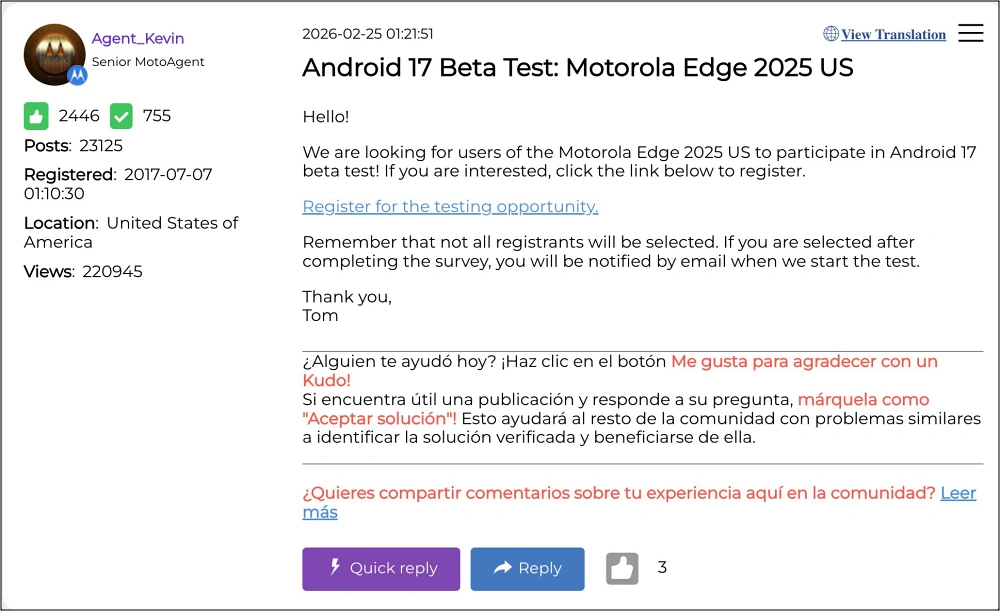
However, prospective participants should temper their excitement with a degree of pragmatic caution. The current rollout is not a general release, nor is it available to the entirety of Motorola’s diverse portfolio. As it stands, the Android 17 beta testing initiative is strictly limited to the Motorola Edge 2025. Furthermore, the program is geographically restricted to users residing within the United States. This localized approach is a common tactic for manufacturers looking to minimize variables during the early stages of software debugging, allowing them to focus on specific carrier configurations and regional network bands before a more global expansion.
The entry requirements for this exclusive testing phase are also quite rigorous. Unlike "Open Beta" programs where any user can simply download a profile and update their device, Motorola is utilizing a "Closed Beta" model. Interested owners of the Motorola Edge 2025 must navigate to a specific application portal—hosted via a Microsoft Form—to submit their credentials and device information. This process serves as a vetting mechanism; Motorola is looking for a specific demographic of testers who can provide constructive feedback and detailed bug reports. Simply filling out the form does not guarantee admission into the program. Successful applicants will be curated by Motorola’s software team and subsequently notified via email once the testing builds are ready for deployment. This selective process ensures that the early, potentially unstable versions of Android 17 are handled by users who understand the risks of running pre-release software, which can include system crashes, battery drain, and data loss.
This methodology draws parallels to the "Closed Beta Test" (CBT) structures utilized by companies like OnePlus. In the OnePlus ecosystem, the CBT is often the first step in a multi-stage rollout, followed by the "Open Beta Test" (OBT) and eventually the stable public release. However, the industry has often noted that these "closed" environments are rarely airtight. In many instances, CBT builds for various OEMs are leaked to the wider public shortly after distribution, often due to a lack of adherence to non-disclosure agreements (NDAs) by the participants. Whether Motorola will face similar leaks remains to be seen, but the intent behind the closed system is to maintain a controlled environment for iron-out technical glitches before the software reaches a broader audience.
The choice of the Motorola Edge 2025 as the pilot device for this program is also telling. As a flagship or high-end upper-midrange contender, the Edge 2025 represents the pinnacle of Motorola’s current engineering. By prioritizing this device, Motorola is ensuring that its most premium customers receive the "first taste" of the new OS, a strategy likely designed to bolster brand loyalty in a highly competitive market. It also serves as a showcase for "Hello UI," Motorola’s modern software overlay that replaced the older "MyUX." The synergy between Android 17’s core features and the refined aesthetics of Hello UI will be a major point of interest for analysts during this beta period.
The broader implications for the Android ecosystem are significant. If a company with a historically sluggish update reputation like Motorola can pivot to become an early adopter, it puts immense pressure on other OEMs to accelerate their own development cycles. Samsung, which has made great strides with its "One UI" beta programs, and OnePlus, known for its "OxygenOS" speed, will likely feel the need to respond quickly to ensure they are not perceived as falling behind. This competition is ultimately a victory for the consumer, as it drives the industry toward a standard of faster, more reliable software delivery.
While the Android 17 "Cinnamon Bun" release is still in its infancy, the features being whispered about in developer circles suggest a heavy emphasis on the "Predictive Back" gesture refinements, improved multi-tasking for foldable and large-screen devices, and even more granular control over background app processes to extend battery life. For Motorola Edge 2025 users who are accepted into the beta, they will be among the first individuals globally to experience these innovations. They will act as the vanguard, helping to identify the inevitable "kinks" that accompany a major OS transition.
In conclusion, Motorola’s early leap into the Android 17 arena is a surprising but welcome development. It signals a potential end to the era of software neglect that has long plagued the brand’s reputation. While the current testing phase is narrow in scope—limited by device, geography, and a selective application process—it represents a symbolic shift in priorities. By being the first player to jump onto the bandwagon, Motorola is not just testing a new operating system; they are testing a new identity as a responsive, forward-thinking manufacturer. As the industry watches the Motorola Edge 2025 closely, the hope remains that this is not an isolated incident, but rather the beginning of a new standard for the company. Users are encouraged to keep a close eye on their inboxes and their "lucky stars," as the era of Cinnamon Bun is arriving much sooner than anyone anticipated, led by the most unexpected of pioneers.
