
Updated on September 26, 2025
The landscape of embedded system maintenance, particularly for devices powered by Amlogic chipsets, has been significantly enhanced by the release and continued relevance of the Amlogic BootCard Maker utility for Windows operating systems. This specialized, lightweight software application is purpose-built to facilitate the creation of meticulously prepared, bootable Secure Digital (SD) cards. Its paramount function revolves around enabling the manual, low-level flashing of system firmware onto Amlogic-based hardware, serving as a critical lifeline when conventional Over-The-Air (OTA) update mechanisms falter or when a device has been rendered inoperable—commonly referred to as "bricked." In scenarios where standard software recovery pathways are inaccessible, this tool provides a robust, hardware-centric avenue for system resuscitation.
The necessity for such a dedicated utility stems from the complex nature of low-level boot processes in System-on-Chips (SoCs) like those manufactured by Amlogic, which are prevalent in Android TV boxes, single-board computers, and various multimedia streaming devices. When the primary bootloader or operating system partition becomes corrupted, the device lacks the inherent functionality to accept updates via standard networking protocols or even traditional USB flashing routines, necessitating the injection of a valid operating system image directly via a preliminary boot medium like an SD card.
The Amlogic BootCard Maker encapsulates several key features designed to streamline this often-daunting technical procedure, transforming it into a more manageable process even for technicians who may not possess deep expertise in low-level binary manipulation.
Core Functionality: Engineering Bootable Firmware Deployments
At the heart of the Amlogic BootCard Maker is its capability to engineer complete, bootable SD card images loaded with the requisite Amlogic firmware. This process is far more involved than a simple file copy operation. The software ensures that the firmware image—which contains the bootloader, kernel, and potentially the entire root filesystem—is written to the SD card in a manner that the target Amlogic hardware recognizes immediately upon power-on. This capability is indispensable for restoring operational status to hardware exhibiting severe corruption, effectively rewriting the foundational software layer that dictates device initialization.
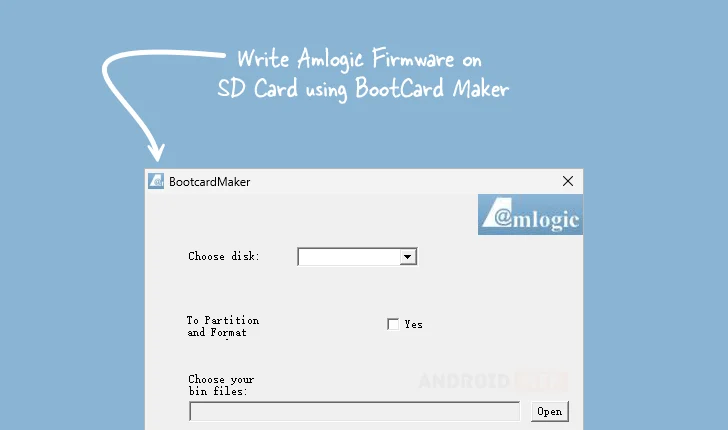
The utility’s graphical user interface (GUI) is a significant departure from command-line-driven recovery methods, prioritizing ease of use without sacrificing technical precision. This user-friendly design allows operators to intuitively perform the necessary preparatory steps: selecting the target SD card from available drives, configuring the necessary disk partitioning scheme, executing a clean format operation, and precisely pointing the application toward the desired firmware file. By abstracting the complexity of disk geometry and partition table creation, the BootCard Maker democratizes the firmware recovery process, significantly lowering the barrier to entry for individuals attempting to revive expensive or mission-critical hardware.

Precision in Preparation: Partitioning and Formatting Integrity
A crucial, often overlooked aspect of successful boot media creation is the underlying structure of the storage medium itself. The Amlogic BootCard Maker addresses this directly by incorporating automated partitioning and formatting functions tailored specifically for Amlogic device requirements. Unlike generic formatting tools, this utility ensures that the SD card’s structure—including the size, type, and alignment of the primary boot partition—conforms precisely to the expectations of the Amlogic boot ROM. Errors in this initial structure are a frequent cause of failure during low-level flashing attempts; thus, the automated validation and preparation performed by the software substantially mitigate the risk of boot sequence failure caused by improper media configuration.
Furthermore, the application exhibits robust compatibility with standard firmware image formats commonly employed in Amlogic ecosystems. Specifically, its support for .bin files is vital. These binary files often encapsulate critical components such as the primary bootloader (e.g., U-Boot variants) or consolidated system images. This broad compatibility ensures that technicians are not restricted by niche proprietary formats, allowing them to utilize widely available or custom-compiled firmware packages for targeted repairs or feature updates.
Operational Flexibility and Strategic Advantage
A key operational advantage of the Amlogic BootCard Maker is its nature as a portable application. Requiring no formal installation process, the executable file can be launched directly from any Windows machine, including removable media. This portability is a significant asset for service centers, field technicians, and advanced hobbyists who frequently move between different host computers. It eliminates the administrative overhead of installing drivers or registering components, ensuring that the recovery tool is immediately available wherever the problematic hardware is located, while also conserving host machine storage resources.
Strategically, the BootCard Maker offers a vital alternative pathway when traditional recovery methods, most notably those involving the Amlogic USB Burning Tool, are rendered useless. USB-based recovery relies on the device’s USB On-The-Go (OTG) port being recognized by the host PC, a function often dependent on the device’s initial bootloader being partially functional. When even this low-level USB communication fails—perhaps due to severe corruption affecting the USB initialization routines—the SD card boot method takes precedence. By initiating the boot sequence from a pre-configured SD card, the system bypasses the need for initial USB enumeration, allowing the device to load a recovery kernel or flashing utility directly from the card, thus significantly widening the window of opportunity for successful hardware salvage. This SD card recovery method often proves superior in handling deeply embedded hardware failures.
Technical Context and Availability
The continued availability of version 1.01 of the Amlogic BootCard Maker, provided through various trusted repositories, underscores its enduring utility within the technical community dedicated to Amlogic platform maintenance. The provision of clear download links ensures that users can reliably obtain the established, tested version of the software, crucial for reliable system repair work where software stability is paramount.
The utility’s existence reflects a broader trend in the embedded electronics industry: while manufacturers push automated updates, the need for manual, expert-level intervention persists for managing edge cases, custom development, and catastrophic hardware failures. The Amlogic BootCard Maker stands as a testament to community-driven tooling that fills the gap left by overly simplified commercial software, empowering users to take direct, granular control over their device’s foundational software layer. Its specific focus on Amlogic chipsets—which power a vast segment of the global market for streaming media players and IoT hubs—ensures its sustained relevance as these platforms evolve and as users seek longevity beyond official support cycles.
| Version | Download |
|---|---|
| 1.01 | Link |
The capacity of this utility to reliably create a bootable medium capable of injecting new firmware through the SD interface is a cornerstone capability for advanced diagnostics and comprehensive device restoration, securing its place as an indispensable tool for Amlogic platform technicians worldwide.
