

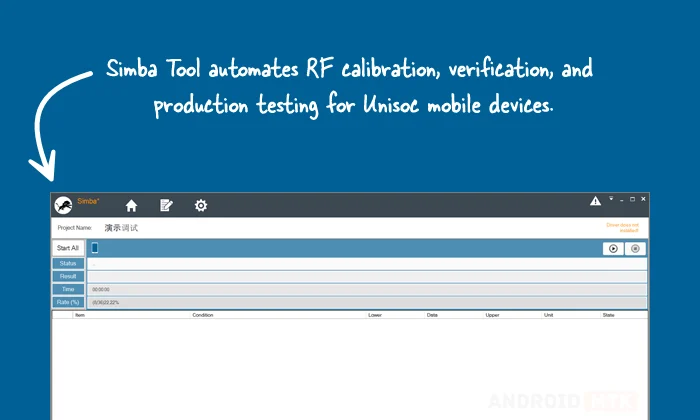
In the rapidly evolving landscape of mobile telecommunications, the demand for high-precision, high-efficiency manufacturing processes has never been greater. As smartphone hardware becomes increasingly sophisticated, the integration of cellular modems, RF modules, and complex security protocols requires specialized software solutions to maintain quality control. Developed by Unisoc—formerly known as Spreadtrum Communications—the Simba Tool stands as a cornerstone of the modern production line. It is a comprehensive, highly integrated automatic test system (ATS) engineered to facilitate the calibration, verification, and software deployment stages of mobile device assembly. By bridging the gap between hardware testing and manufacturing software, Simba Tool has become an indispensable asset for engineers tasked with ensuring that millions of units meet stringent performance standards before reaching consumers.
At its core, the Simba Tool is designed to address the multifaceted challenges of the factory environment. Manufacturing a mobile device involves far more than simply assembling physical components; it requires the precise configuration of firmware, the calibration of radio frequency paths, and the secure injection of unique identifiers. Simba Tool acts as the central orchestrator for these tasks, providing a unified interface that simplifies what would otherwise be a disjointed and error-prone series of manual interventions. By automating the workflow, the tool minimizes human error, significantly boosts throughput, and ensures that every device leaving the production line adheres to the specifications defined by the chipset manufacturer.
The primary strength of the Simba Tool lies in its advanced RF calibration and verification capabilities. Radio Frequency performance is the lifeline of any mobile device, and even minor deviations in signal accuracy can lead to dropped calls, poor data speeds, or connectivity failures. The software provides an exhaustive suite of tools to calibrate cellular technologies, spanning the legacy 2G and 3G networks up to the high-speed requirements of 4G LTE. Beyond cellular connectivity, it handles the verification of Wireless Connectivity Network (WCN) systems, including WiFi, Bluetooth, and GPS modules. By executing automated RF path loss correction, the tool ensures that every device’s antenna system is perfectly tuned to operate within the optimal power and sensitivity ranges required by global telecommunications standards.
Hardware integrity is another critical pillar addressed by the Simba system. Early detection of hardware defects is paramount to reducing costs and minimizing e-waste. Simba Tool incorporates robust antenna testing protocols and real-time current consumption measurement features. By monitoring the power draw of the Device Under Test (DUT), the system can instantly identify potential shorts, leakage issues, or power management integrated circuit (PMIC) malfunctions. This proactive approach to quality assurance allows engineers to isolate faulty hardware during the assembly phase, preventing the shipping of defective units and protecting the brand’s reputation.
In an era where data security and device authenticity are non-negotiable, the Simba Tool offers a secure and centralized method for managing device identifiers and cryptographic keys. Every mobile device requires a unique digital identity, and Simba simplifies the writing and verification of International Mobile Equipment Identity (IMEI) numbers, Serial Numbers (SN), Media Access Control (MAC) addresses, and Mobile Equipment Identifiers (MEID). Furthermore, the tool facilitates the deployment of critical security protocols, such as SIMLOCK, which binds a device to specific carriers, and advanced security frameworks like Google Attestation Keybox, IFAA, and Soter. These features ensure that the device’s software environment is secure and that the identity of the hardware remains verifiable throughout its lifecycle.

Beyond the technical calibration of components, Simba Tool serves as the bridge between the device and the factory’s digital infrastructure. It is fully compatible with Manufacturing Execution Systems (MES), which serve as the "brain" of the production facility. By integrating directly with these systems and local databases, Simba enables seamless tracking, reporting, and data logging for every DUT. This level of traceability is vital for quality audits and long-term diagnostic analysis. Whether it is pushing the latest firmware to a device or recording the pass/fail result of a specific calibration test, the tool ensures that information flows smoothly from the production floor to the management dashboard.
Efficiency on the production line is measured by the number of units that can be processed per hour, and Simba Tool addresses this with high-performance multi-DUT support. The system is engineered to manage the simultaneous testing of up to four individual devices. This parallel processing capability is a game-changer for high-volume manufacturing, as it maximizes the utilization of hardware testers and significantly reduces the bottlenecking typically associated with manual calibration. To manage this complexity, the software features a sophisticated sequence editor, allowing production test engineers to customize the test items based on the specific hardware configuration of the device model being processed.
The user interface of the Simba Tool is designed with the operational reality of the factory floor in mind. It provides real-time status monitoring, allowing operators to oversee the progress of each test cycle at a glance. In the event of a failure, the system provides immediate feedback through pass/fail reporting and integrated alarm notifications. This instant visibility ensures that if a specific station or device begins to exhibit anomalies, the production line can be paused or adjusted before thousands of units are affected. Such granular control is what separates a standard testing tool from an enterprise-grade manufacturing suite.
For professionals and service technicians looking to implement or utilize these solutions, Unisoc provides the software in various iterations to match the evolving needs of hardware development. The Simba Tool is optimized for the Windows environment, ensuring compatibility with the workstations typically found in industrial testing environments. Whether running on a 32-bit or 64-bit architecture, the software is designed to be stable, responsive, and easy to deploy. The availability of multiple versions, such as R8.0.0001 and R8.0.0015, reflects the tool’s ongoing evolution to support new chipset architectures and tighter regulatory requirements.
The implementation of Simba Tool represents a strategic investment in manufacturing reliability. By consolidating RF calibration, firmware management, and security deployment into a singular, automated ecosystem, Unisoc has provided the industry with a blueprint for how modern electronics should be validated. As mobile technology continues to progress toward higher levels of complexity, the role of such integrated systems will only grow in importance. For manufacturers, the goal remains the same: to deliver high-quality, reliable, and secure devices to consumers, and the Simba Tool remains the most effective conduit for achieving that outcome in the Unisoc-based hardware ecosystem. Through its combination of rigorous testing, seamless database integration, and high-volume scalability, it remains the standard-bearer for production line efficiency in the mobile telecommunications sector.
