

Updated on September 26, 2025
The landscape of embedded systems maintenance, particularly for hardware powered by Amlogic chipsets prevalent in media players, set-top boxes, and single-board computers, has gained a significant new resource with the introduction of the Amlogic BootCard Maker for Windows. This specialized, compact utility is engineered specifically to facilitate the creation of bootable Secure Digital (SD) cards, serving as a critical, often last-resort mechanism for manually injecting firmware onto these devices. Its utility shines brightest in dire scenarios where conventional Over-The-Air (OTA) software updates have encountered insurmountable errors, or when the device has suffered a catastrophic failure, rendering it completely inoperable—a state commonly referred to as being "bricked."
The necessity for tools like the Amlogic BootCard Maker stems from the inherent vulnerabilities in software deployment for specialized hardware. While OTA updates offer convenience, they rely on the existing, functioning operating system environment. When this environment is corrupted—perhaps due to a power surge during an update, faulty storage media, or an improperly compiled firmware package—the device loses its ability to communicate or initiate standard recovery protocols. In such cases, direct hardware-level intervention via external, stable media becomes the only viable pathway back to operational status. The BootCard Maker simplifies this complex procedure by abstracting the intricacies of partition management and file system preparation into a streamlined application.
The core functionality revolves around transforming standard SD cards into self-sufficient recovery mechanisms capable of initiating the boot process on Amlogic-based hardware, thereby overriding the corrupted internal memory state. This capability positions the tool as an invaluable asset for both advanced hobbyists and professional technicians who frequently encounter Amlogic devices requiring deep-level system restoration.
Comprehensive Feature Set Driving Device Recovery
The Amlogic BootCard Maker is distinguished by a suite of integrated capabilities meticulously designed to ensure a high success rate when writing recovery firmware. These features address the various technical hurdles associated with preparing bootable media for embedded systems.
Precision in Firmware Image Creation
At its heart, the utility excels at the precise creation of bootable SD cards preloaded with the necessary Amlogic firmware images. This process is far more involved than a simple file copy operation. The software ensures that the firmware package—which typically contains the bootloader, kernel, and root filesystem components—is written to the SD card in a sector-by-sector manner that the Amlogic System-on-Chip (SoC) is programmed to recognize during its initial power-on sequence. Successfully provisioning this image allows the device to boot from the external card, bypassing the internal memory entirely and enabling the user to then flash a clean, stable operating system onto the device’s internal eMMC or NAND storage. This function is absolutely paramount for resurrecting hardware that has otherwise ceased to respond to external commands.
Intuitive Graphical User Interface for Accessibility
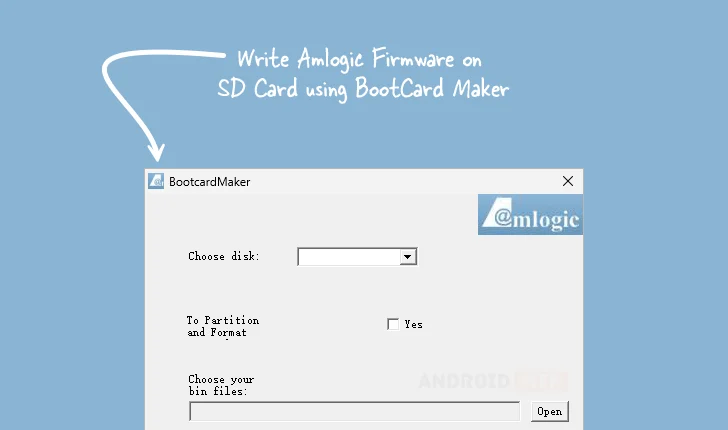
Recognizing that not all users possess deep command-line expertise, the developers have prioritized the development of a clean, intuitive Graphical User Interface (GUI). This design philosophy democratizes the recovery process. Users are guided through a logical sequence of steps: selecting the target SD card from a list of connected drives, defining the necessary partitioning scheme, initiating the required formatting routines, and finally, pointing the application toward the specific firmware file intended for deployment. By translating complex, often error-prone manual steps into simple graphical selections, the tool significantly lowers the barrier to entry for firmware recovery, transforming what might otherwise require familiarity with low-level disk utilities into a manageable task for a broader audience.

Automated Partitioning and Formatting Capabilities
A critical element often overlooked in manual recovery attempts is the exact structure of the storage media. Amlogic hardware often requires specific partition layouts, frequently involving distinct boot partitions formatted with particular file systems (such as FAT32 for initial loading) before the main system partition is established. The BootCard Maker handles this complexity automatically. It manages the entire pre-write preparation sequence, including the meticulous partitioning and subsequent formatting of the SD card. This automation drastically reduces the probability of boot failures stemming from incorrectly sized, unformatted, or improperly aligned partitions, ensuring the card’s structure is perfectly tailored to the requirements of the Amlogic boot ROM.
Broad Compatibility with Standard .bin Firmware Files
Flexibility in firmware sourcing is a hallmark of effective recovery utilities. The Amlogic BootCard Maker natively supports the industry-standard .bin file format commonly used for distributing Amlogic bootloaders and complete system images. This widespread adoption means technicians are not restricted to proprietary file types; they can readily utilize official manufacturer releases, community-developed firmware builds, or specialized binaries (like updated bootloader files) that are frequently distributed in this universal format. This compatibility enhances the tool’s versatility across a wide array of Amlogic hardware revisions and device types.
Portability: Zero Installation Requirement
The utility operates as a truly portable application. It requires no formal installation procedure on the host Windows machine. Users can execute the program directly from its downloaded location—whether from a local drive, a network share, or even another USB drive. This portability is immensely beneficial for field technicians or individuals maintaining multiple workstations, as it eliminates the need to install specialized software on every machine they use, preserving system cleanliness and allowing for rapid deployment of the recovery solution across various computing environments.
A Vital Alternative to USB Burning Protocols
The BootCard Maker provides a crucial alternative pathway when traditional USB-based recovery methods prove ineffective. Many Amlogic devices utilize the USB Burning Tool for flashing firmware, which requires the device to successfully enter a specific USB download mode. In cases where the bootloader is so severely damaged that it cannot even initialize the USB interface correctly, the SD card method becomes the sole option. By leveraging the hardware’s ability to read from an SD slot—a function often initialized at a lower hardware level than the USB stack—the BootCard Maker circumvents the dependency on a functioning USB recovery handshake, significantly broadening the scope of recoverable devices. This SD card recovery method acts as a robust fallback mechanism when USB communication channels are compromised.
Availability and Deployment
The Amlogic BootCard Maker is currently offered as version 1.01 and is compatible with both 32-bit and 64-bit iterations of the Windows operating system, ensuring wide applicability across modern computing platforms. The developers have made the tool readily available for download to support the community and professional repair sectors.
The distribution mechanism follows a standardized model, providing direct access points for immediate acquisition. Users seeking to integrate this utility into their diagnostic toolkit can access the required files via the following structured repository:
| Version | Download |
|---|---|
| 1.01 | Link to BootCard Maker v1.01 via androiddatahost.com |
The availability of a direct download link ensures that technicians can quickly obtain the necessary software without navigating complex registration portals or relying on potentially insecure third-party mirrors, promoting trust and rapid deployment of the recovery solution. The continuous support for this utility underscores its recognized importance in maintaining the longevity and repairability of hardware reliant on Amlogic processing platforms.
