
The landscape of the Android ecosystem has long been defined by a precarious balance between user freedom and corporate security mandates. For years, the custom ROM community—a vibrant collective of developers and enthusiasts dedicated to extending the life of hardware and enhancing user privacy—has been locked in an escalating arms race with Google. The primary weapon in Google’s arsenal is the Play Integrity API, a sophisticated suite of checks designed to ensure that a device’s software environment has not been tampered with. For users of alternative operating systems like LineageOS, /e/OS, or GrapheneOS, this has resulted in a frustrating "walled garden" effect, where essential services such as banking, digital identity, and contactless payment apps refuse to function. However, a new European initiative titled Unified Attestation is emerging as a potential disruptor, promising to break Google’s unilateral control over device legitimacy.
To understand the significance of Unified Attestation, one must first grasp the technical stranglehold currently exerted by Google’s Play Integrity. Formerly known as SafetyNet, Play Integrity performs a multi-tiered evaluation of a device. It checks for "Basic Integrity," ensuring the system hasn’t been obviously compromised; "Device Integrity," which confirms the device is a certified Android product with a locked bootloader; and "Strong Integrity," which utilizes hardware-backed security modules to provide the highest level of assurance. For the average user, installing a custom ROM requires unlocking the bootloader—an action that immediately triggers a failure in the Play Integrity test. Consequently, financial institutions and high-security app developers, relying on Google’s verdict, flag these devices as "untrusted," effectively rendering them useless for modern digital life.
This systemic exclusion has driven a significant decline in the adoption of alternative mobile operating systems. Users who prioritize privacy or wish to "de-Google" their lives are often forced back into the mainstream ecosystem simply because they cannot pay for groceries or check their savings account on a modified device. Unified Attestation aims to solve this dilemma by providing a transparent, open-source alternative to Google’s proprietary verification system.

The initiative is the brainchild of Volla Systeme, a German smartphone manufacturer known for its privacy-centric hardware. Volla is not acting alone; the project has garnered significant support from a coalition of major players in the European alternative mobile space, including Murena (the developers of /e/OS), the team behind the privacy-focused iodé OS, and the Swiss-based Apostrophy OS. Together, these entities represent a concerted effort to establish "technological sovereignty" within Europe, reducing reliance on American tech giants for core security infrastructure.
At its core, Unified Attestation is designed to be a free, open-source framework that delivers short-lived integrity tokens. Unlike Google’s model, which requires a persistent connection to Google Play Services and centralized servers, Unified Attestation utilizes a federated approach. The tokens are signed by a backend that can be verified offline by app servers, and they are issued via a privileged Android system service. This architecture is intended to be lean, transparent, and, most importantly, independent of the Google ecosystem.
Dr. Jörg Wurzer, the CEO of Volla Systeme GmbH, has positioned Unified Attestation as a bridge rather than a barrier. He argues that the initiative creates a trustworthy procedure for security checks that developers can rely on without forcing users into a specific corporate ecosystem. By making the process publicly verifiable, the consortium hopes to build a system where trust is earned through transparency rather than mandated through proprietary algorithms. Wurzer’s vision is one where companies can check the integrity of competitors’ products through a shared, open standard, thereby strengthening the overall security of the mobile market.
The technical differentiation between the two systems is stark. While Google Play Integrity is a "black box" controlled entirely by Mountain View, Unified Attestation is built on the principle of open-source scrutiny. Furthermore, Unified Attestation leverages Android Hardware Attestation. This is a critical distinction because hardware-level security, such as the Trusted Execution Environment (TEE) and StrongBox, is significantly more difficult to bypass than software-based checks. While rooting tools like Magisk have historically engaged in a game of "cat and mouse" to hide system modifications from Google, hardware-backed keys are burned into the silicon, making them a more robust foundation for genuine security—provided the attestation framework is implemented correctly.

However, the road to widespread adoption is fraught with challenges. For Unified Attestation to be effective, app developers must choose to integrate it. Volla claims that this transition is relatively painless, requiring only a few lines of code to be added to existing applications. Yet, the reality of the app market is that most developers optimize for the largest possible audience with the least amount of effort, which usually means sticking with Google’s default tools. The success of this initiative will likely depend on whether European regulators, under frameworks like the Digital Markets Act (DMA), decide to mandate support for alternative attestation methods to ensure a level playing field for smaller operating system vendors.
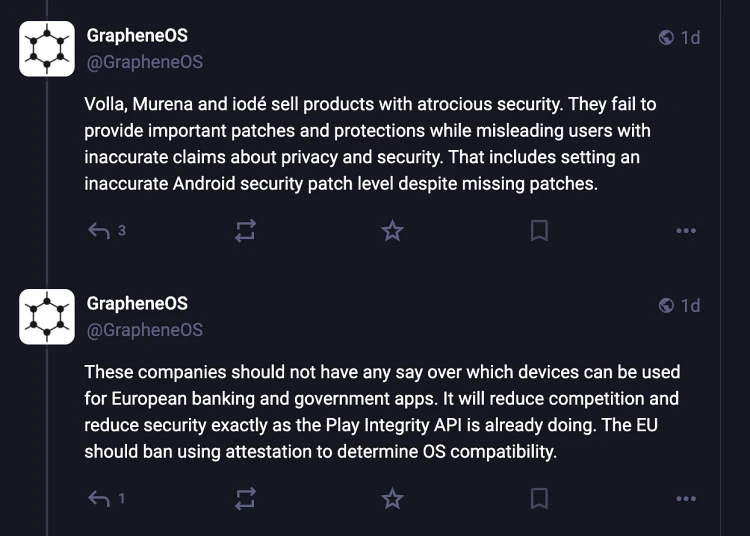
Despite its noble goals, Unified Attestation has not been met with universal acclaim within the privacy community. One of the most vocal critics is the team behind GrapheneOS, a hardened Android-based operating system frequently cited as the gold standard for mobile security. In a series of public statements, GrapheneOS expressed strong opposition to the initiative, calling on developers to avoid it entirely. Their critique is rooted in a fundamental philosophical disagreement regarding the nature of device attestation.
GrapheneOS argues that neither Google’s Play Integrity nor the new Unified Attestation should exist in their current forms. They contend that these systems are inherently anti-competitive, allowing hardware and software vendors to act as gatekeepers who decide which operating systems are "allowed" to run specific apps. According to GrapheneOS, the solution is not to create a second, competing attestation system but to regulate such practices out of existence. They argue that "root-based attestation" is fundamentally insecure and that any system where a company permits its own products while potentially disallowing others is a step backward for user freedom.
This internal rift highlights a complex debate within the tech world. On one side, Volla and its partners believe that since app developers demand security checks, the most pragmatic solution is to provide an open, fair, and transparent way to satisfy those demands. On the other side, GrapheneOS views the very concept of remote attestation as a threat to user sovereignty, fearing it will eventually be used to enforce Digital Rights Management (DRM) and further restrict what users can do with their own hardware.

The controversy also touches on the history of the "De-Googled" movement. Some observers have suggested that the friction between GrapheneOS and the Unified Attestation group may be influenced by past disagreements between the various OS projects. However, the technical arguments raised—specifically concerning the security of hardware-backed keys versus software-based trust—remain a central point of contention that the industry must eventually address.
As Unified Attestation prepares for a wider rollout, its impact will be closely watched by tech enthusiasts and regulatory bodies alike. If successful, it could provide a lifeline for the custom ROM community, allowing users to enjoy the benefits of an open-source operating system without sacrificing the functionality of modern mobile banking and payment systems. It represents a significant attempt to decentralize trust in the mobile era, moving away from a world where a single company in Silicon Valley acts as the ultimate arbiter of what constitutes a "safe" device.
Ultimately, the battle between Play Integrity and Unified Attestation is about more than just code; it is a battle for the future of the smartphone. It asks whether we are moving toward a future of locked-down "appliances" controlled by their manufacturers, or whether we can maintain the smartphone as a general-purpose computer that belongs truly to the user. For the developers at Volla, Murena, and iodé, Unified Attestation is the necessary infrastructure for a free market. For their critics, it is a well-intentioned but flawed attempt to play a game whose rules are rigged from the start. As the project moves toward its official launch, the global developer community will have to decide which side of the wall they want to build on.
