
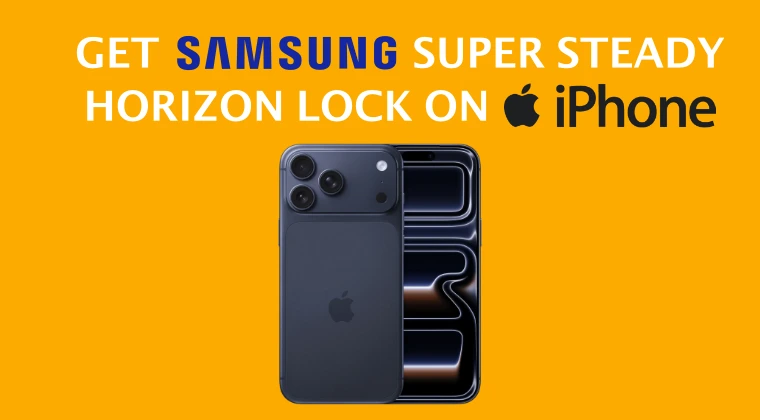
The landscape of mobile cinematography has undergone a seismic shift with the release of the latest flagship devices, most notably the Samsung Galaxy S26 Ultra. While the industry has been buzzing about the device’s controversial Privacy Display—a feature that, despite its functional utility, has drawn criticism for significantly degrading screen clarity and brightness—another feature has captured the imagination of videographers worldwide. This feature is the Super Steady Horizon Lock. While Samsung is not technically the first manufacturer to experiment with such technology, its massive global market presence has acted as a catalyst, bringing a specialized stabilization technique previously reserved for high-end action cameras into the mainstream consciousness. However, iPhone users need not feel sidelined by this technological leap, as a sophisticated open-source solution has emerged to bring identical, and in some ways superior, stabilization capabilities to the iOS platform.
To understand the value of this development, one must first grasp the mechanics of a Horizon Lock. In traditional electronic image stabilization (EIS), software attempts to smooth out shakes and jitters by cropping into the sensor’s field of view and shifting the frame to compensate for movement. Horizon Lock takes this several steps further. It is a specialized stabilization algorithm that ensures the camera’s horizon remains perfectly level, regardless of whether the smartphone is tilted, shaken, or even rotated through a full 360-degree circle. For the viewer, the result is a surreal, gimbal-like experience where the world remains upright even as the operator performs complex maneuvers. This technology is particularly transformative for sports videography, handheld vlogging, and cinematic chase sequences where maintaining a consistent level of orientation is paramount to professional-quality output.
The bridge between Samsung’s proprietary hardware-software synergy and the iPhone’s ecosystem comes in the form of a groundbreaking application titled "Stable Action." Developed by the independent creator known as scienceLabwork, Stable Action is an open-source project designed to replicate and enhance the Super Steady Horizon Lock experience on iOS. The app operates on a fundamental principle of modern digital imaging: it utilizes the iPhone’s ultra-wide sensor to create a massive "buffer" area. By cropping into this wide field of view, the software can counter-rotate the crop window in real-time based on data received from the device’s internal gyroscope. This counter-rotation is executed at a staggering 120 Hz, ensuring that the adjustment is invisible to the human eye and results in a fluid, unshakeable video feed.
What sets the Stable Action implementation apart from standard manufacturer offerings is its inclusion of translation correction. While many horizon-locking tools focus solely on rotational movement (roll), Stable Action incorporates velocity-damped stabilization for X and Y axes (up, down, left, and right). This provides a "gimbal-feel" where the camera seems to float through space, compensating for the natural drift of a human hand. Samsung’s marketing has largely focused on the 360-degree roll, but the addition of translation compensation on the iPhone provides a more comprehensive suite of stabilization tools for the end-user.
The technical architecture of Stable Action is deeply integrated with the iPhone’s Internal Signal Processor (ISP). Specifically, the app leverages the .cinematicExtendedEnhanced mode within the iPhone’s hardware Action Mode. This allows the software to utilize Apple’s existing high-performance stabilization frameworks while overlaying the custom horizon-lock algorithms. The app offers two primary operating states: Normal Mode and Action Mode. In Normal Mode, the app utilizes the 1x Wide lens, providing a full-frame sensor readout for standard recording. However, the true power of the software is found in Action Mode. In this setting, the app switches to the Ultra-wide lens, which provides the necessary overhead for the 360-degree continuous roll correction. Unlike some basic stabilization apps that "flip" or glitch when the phone reaches a 180-degree inversion, Stable Action utilizes continuous angle unwrapping to ensure a seamless transition through a full circle.
The user interface of Stable Action is designed to be a "what you see is what you get" experience. In many professional camera apps, the preview on the screen differs from the final recorded file due to the heavy processing required for stabilization. ScienceLabwork has engineered a unified pipeline where the live preview is identical to the recorded output, eliminating any guesswork for the cinematographer. Additionally, the app includes essential features such as "Tap to Focus," which allows users to lock both focus and exposure on specific subjects, and an integrated gallery browser for full-screen playback of captured footage. To ensure a seamless workflow, the app is configured to automatically save all recordings directly to the iOS Photos library upon the conclusion of a recording session.
Despite its professional-grade capabilities, Stable Action is not available through the traditional Apple App Store. This is largely due to the app’s use of deep system integrations and its open-source nature, which often falls outside of Apple’s stringent commercial guidelines. Consequently, users looking to enhance their iPhone’s videography must turn to the world of "sideloading." Sideloading is the process of installing applications onto an iOS device using an IPA file (the iOS equivalent of an EXE or APK) via a computer. While this process requires a few additional steps compared to a standard download, it is a well-trodden path for power users and enthusiasts.
The two primary methods for installing Stable Action are via AltStore and Sideloadly. AltStore is widely considered the gold standard for sideloading, as it creates a localized server on the user’s computer to "sign" the app with the user’s Apple ID, making it appear as a personally developed application to the iOS security system. Sideloadly offers a more direct, lightweight approach for those who prefer a simpler interface. Both methods require the user to enable "Developer Mode" within the iOS settings—a security feature introduced by Apple to allow for the testing of non-Store applications. Once installed, the app functions like any other native tool, providing immediate access to the Super Steady features.
Operating the Horizon Lock on an iPhone is a straightforward affair once the initial setup is complete. Upon launching Stable Action, the user is presented with a clean viewfinder. To engage the full stabilization suite, the user must toggle the "Action Mode" icon. It is important to note that because the app uses the Ultra-wide lens to facilitate the 360-degree rotation, the image will appear "zoomed in" compared to the standard wide-angle view. This is the necessary trade-off for perfect stability; the software needs those outer edges of the sensor to "lean into" as the phone rotates. Once the record button is pressed, the user can literally spin the phone like a propeller, and the resulting footage will remain as level as if the camera were mounted on a heavy-duty tripod.
The emergence of tools like Stable Action highlights a growing trend in the mobile industry: the democratization of high-end cinematic tools. For years, achieving a perfectly level horizon during high-intensity movement required expensive motorized gimbals or specialized software in post-production. Now, through the ingenuity of the open-source community and the raw power of modern smartphone silicon, this capability is available to anyone with an iPhone and the willingness to explore beyond the App Store.
As Samsung continues to push the boundaries with the S26 Ultra and its successors, it is clear that the competition in the smartphone arena is no longer just about megapixel counts or zoom ranges. The new frontier is "usable" footage—the ability to capture professional-quality content in chaotic, real-world environments. By bringing Super Steady Horizon Lock to the iPhone, developers are ensuring that the iOS ecosystem remains at the forefront of this revolution. Whether you are a professional filmmaker looking for a "B-cam" that can handle extreme motion or a casual user wanting to capture smoother videos of your travels, the ability to lock the horizon is a transformative addition to the mobile toolkit. The gap between professional cinema cameras and the device in your pocket has never been smaller.
