

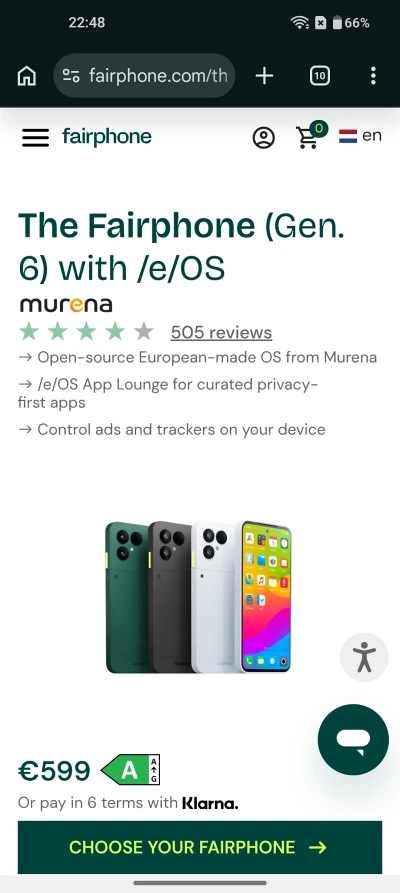
A significant technical anomaly has surfaced within the Android ecosystem, specifically targeting Samsung Galaxy devices equipped with the company’s proprietary Exynos chipsets. Security researchers and tech enthusiasts have identified a seemingly innocuous URL that, when accessed via a mobile browser, induces an immediate and involuntary system reboot. While the internet is frequently home to malicious links designed to phish for credentials or install intrusive malware, this particular incident is unique. The URL in question is not a dark-web portal or a known phishing site; rather, it is a legitimate product page for the Fairphone (Gen. 6) running the privacy-focused /e/OS operating system. The discovery has sent ripples through the mobile community, highlighting a rare, hardware-specific vulnerability that distinguishes Samsung’s global hardware variants from their North American counterparts.
The digital landscape is no stranger to "crash strings" or "death links"—sequences of characters or specific files that overwhelm a device’s processing capabilities. However, this event is categorized by its peculiar hardware selectivity. Internal testing and user reports confirm that the crash is exclusive to the Exynos architecture. Samsung traditionally employs a dual-chip strategy for its flagship S-series and A-series devices, utilizing Qualcomm Snapdragon processors for the United States, South Korea, and Chinese markets, while deploying its in-house Exynos chips to Europe, India, and other international regions. In this instance, users wielding Snapdragon-powered Galaxy devices have reported no adverse effects when visiting the Fairphone website, navigating the page with standard fluidity. Conversely, those with Exynos-powered models—ranging from the latest flagship iterations to older mid-range devices—find themselves trapped in a cycle of system instability.
The mechanics of the crash vary slightly among the affected user base, pointing to a complex interaction between the browser’s rendering engine and the underlying hardware drivers. For a significant portion of the affected demographic, the failure is instantaneous. Upon clicking the link or entering the address into a browser such as Chrome or Samsung Internet, the screen freezes momentarily before the device cuts power and initiates a full system restart. However, a more concerning subset of users has reported a delayed reaction. In these cases, the device does not immediately reboot but instead experiences a rapid and intense thermal spike. The processor appears to enter an infinite loop of high-intensity computation, causing the chassis to heat up significantly. After several seconds of unresponsiveness and thermal stress, the kernel panics, and the device reboots as a protective measure to prevent permanent hardware damage.
One of the most baffling aspects of this phenomenon is the role of network connectivity. Preliminary data suggests that the severity and occurrence of the crash may be influenced by the type of connection being used. While the majority of users experience the reboot regardless of whether they are on a cellular 4G/5G network or a local Wi-Fi connection, a specific group of users has noted that the crash only triggers when connected to Wi-Fi. This nuance suggests that the bug might not reside solely within the graphics rendering pipeline but could potentially involve the network stack or the way the Exynos modem handles specific data packets or compression protocols associated with the Fairphone website’s assets.
As news of the "reboot link" spread, the tech community attempted various localized workarounds to mitigate the risk. One prevalent suggestion involved the use of Samsung’s "Secure Folder" feature. Secure Folder is a robust security solution powered by the Samsung Knox platform, which creates a private, encrypted space on the device. It essentially acts as a sandbox, isolating applications and data within it from the rest of the operating system. The logic behind this attempt was sound: if the URL contained a script or an asset that triggered a system-level fault, the sandboxed environment should, in theory, contain the crash and prevent the entire handset from restarting. Unfortunately, these efforts proved futile. Even when the browser was executed within the Secure Folder environment, the Exynos-based devices succumbed to the reboot. This failure indicates that the vulnerability exists at a much lower level than the application layer—likely within the kernel, the hardware abstraction layer (HAL), or the GPU drivers—allowing the fault to bypass the software-based isolation provided by Knox.

The technical community is currently speculating on the root cause of this "sorcery," as Samsung has yet to issue a formal technical post-mortem. A leading theory suggests a flaw in how the Exynos-specific Mali GPU handles a particular image format or a CSS rendering property present on the Fairphone page. The website in question utilizes high-quality imagery and modern web design elements to showcase the Fairphone (Gen. 6) with /e/OS. It is possible that the site contains a specific SVG filter, a malformed WebP image, or a hardware-accelerated video codec that the Exynos display driver cannot interpret correctly. When the browser attempts to hand off the rendering of this specific element to the hardware, the driver likely encounters an unhandled exception, leading to a total system collapse.
This incident mirrors past historical anomalies in the smartphone industry. For example, several years ago, a specific "cursed" wallpaper image caused Android phones to crash because the image’s color profile exceeded the bounds of what the Android color engine could process. Similarly, Apple’s iOS has historically been plagued by specific strings of Unicode characters that, when rendered in a notification, would cause iPhones to enter a boot loop. The Fairphone URL incident, however, is distinct because of its hardware-exclusive nature. It highlights the subtle but critical differences in how different chipsets interpret the same set of instructions.
The Fairphone organization itself is an unintended party in this technical drama. As a company dedicated to ethical sourcing and repairability, their website is designed for standard e-commerce and informational purposes. The /e/OS mentioned in the URL is a de-Googled version of Android, focused on user privacy. There is no evidence to suggest that the website is hosting malicious code. Rather, it appears to be a "perfect storm" of legitimate web code meeting a specific, unpatched flaw in the Exynos firmware. This serves as a stark reminder of the complexity of modern mobile architecture, where millions of lines of code must interact perfectly with physical silicon to maintain stability.
Until Samsung provides an official firmware update or a security patch to address this vulnerability, Exynos users are advised to exercise caution. While a spontaneous reboot is generally not catastrophic for data integrity, the associated heating issues reported by some users could potentially lead to long-term battery degradation if triggered repeatedly. Furthermore, the inability of the Knox-based Secure Folder to contain the crash suggests that there is currently no effective software-side "shield" for this specific trigger.
As the situation develops, the focus remains on Samsung’s engineering teams to identify the specific component—be it the neural processing unit (NPU), the graphics engine, or the memory controller—that is failing. The URL serves as a diagnostic trigger for a deeper issue that could, in theory, be exploited by more malicious actors if the underlying mechanism is not patched. For now, the link remains a digital curiosity: a specific sequence of data that "breaks" one of the world’s most popular hardware platforms while leaving others completely untouched. The official URL responsible for this phenomenon is https://shop.fairphone.com/the-fairphone-gen-6-e-operating-system. Users of Exynos-based Samsung Galaxy devices are warned that clicking this link will likely result in an immediate loss of unsaved work and a forced hardware restart. Updates are expected as soon as Samsung completes its investigation into this unprecedented hardware-software conflict.
