

The Indian refurbished smartphone market has witnessed an unprecedented surge in recent years, driven by a growing demographic of tech-savvy consumers who seek high-end specifications at mid-range prices. For enthusiasts involved in niche communities—such as those who perform custom ROM flashing, device rooting, and kernel modifications—the secondary market is not merely a place to save money, but a vital resource for obtaining hardware for experimentation. Established players like Cashify, ReFit Global, and SahiValue have built varying degrees of consumer trust through transparent grading systems and warranty programs. However, the emergence of newer platforms like GudFast has raised significant questions regarding the transparency of digital marketing tactics and the ethical implications of device grading in the pre-owned electronics sector.
The journey into the operational nuances of GudFast began with a search for the Poco F7, a device that, due to its recent release, remains a rarity on most established refurbished platforms. While industry leaders typically wait several months to accumulate enough stock for a standardized rollout of pre-owned units, GudFast appeared as a notable exception, claiming availability when others did not. This immediate availability often serves as a primary draw for consumers, yet it also necessitates a higher level of scrutiny regarding the source and quality of the inventory.
![Read This Before You Buy a Mobile Phone from GudFast [Risky?]](https://droidwin.com/wp-content/uploads/2026/03/gudfast-should-you-buy-a-phone.webp)
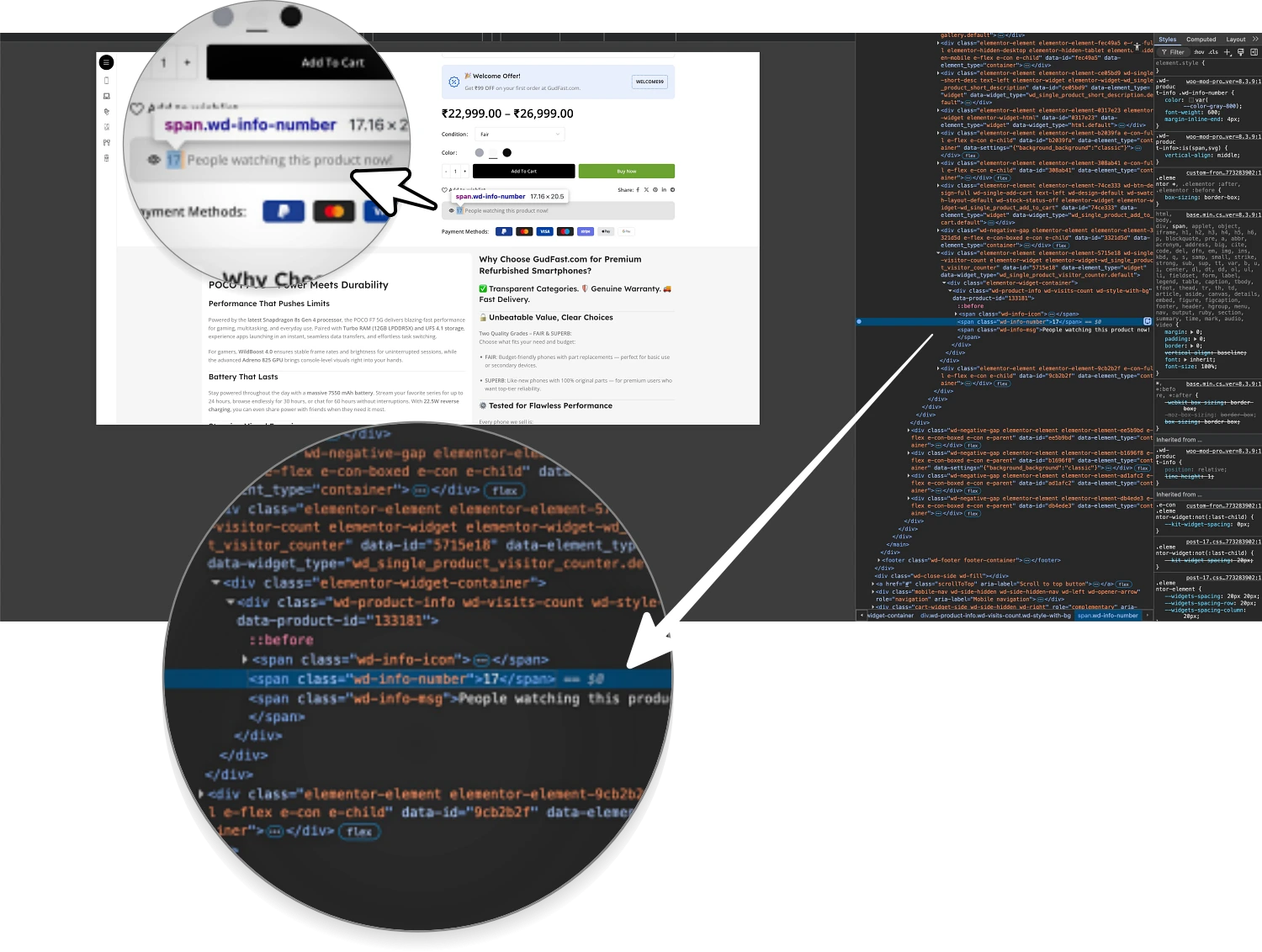
Upon visiting the GudFast interface, a common e-commerce "dark pattern" becomes immediately apparent. The product pages prominently display a live visitor counter, stating that a specific number of people are currently viewing the item. To the average consumer, this creates a sense of "Fear Of Missing Out" (FOMO) and psychological urgency, suggesting that the product might sell out at any moment. However, a technical audit of the website’s front-end code reveals a different reality. By utilizing the "Inspect Element" tool on the browser, the underlying HTML structure exposes the use of the WoodMart theme’s "Visitor Counter" widget.
The technical documentation for this specific plugin confirms that the "wd-info-number" is not a reflection of real-time user traffic. Instead, the widget is designed to generate a random number within a pre-defined range set by the site administrator. The explicit purpose of this feature, as stated in developer documentation, is to create an artificial sense of demand. In the realm of professional digital ethics, such tactics are often categorized as deceptive, as they provide false data to manipulate consumer behavior. For a platform dealing in high-value electronics, where trust is the primary currency, the use of automated "urgency" scripts can be a significant deterrent for informed buyers.
Despite these initial red flags, a comprehensive evaluation requires looking beyond marketing tactics into the legal and structural legitimacy of the business. An investigation into GudFast’s corporate identity involves verifying their Goods and Services Tax Identification Number (GSTIN). In the Indian regulatory framework, the GSTIN is a mandatory 15-digit alphanumeric identifier for any business with a turnover exceeding the statutory threshold. Verification through the official GST portal confirms that GudFast is indeed a registered and legitimate business entity. This legal registration provides a baseline of accountability, ensuring that the company exists in a formal capacity and is subject to national tax laws. However, legal existence does not inherently guarantee consumer-friendly service policies or product quality.
![Read This Before You Buy a Mobile Phone from GudFast [Risky?]](https://droidwin.com/wp-content/uploads/2026/03/people-are-watching-gudfast.webp)
The most critical point of contention arises when analyzing GudFast’s internal grading system and its subsequent impact on consumer rights. In the refurbished industry, devices are typically categorized into tiers such as "Superb," "Good," and "Fair." In a standard consumer-centric model, like that employed by Cashify, a "Fair" grade usually denotes a device with significant cosmetic wear—scratches, dents, or paint peeling—while maintaining the integrity of the original internal components. The value proposition is clear: the consumer accepts a lower aesthetic standard in exchange for a lower price, without sacrificing the reliability of the manufacturer’s original hardware.
GudFast’s definition of the "Fair" category deviates sharply from this industry norm. According to their own policy disclosures, a "Fair" category device is explicitly labeled as a "Parts Changed Phone." This indicates that the device has undergone repairs using non-original, local, or "cheap" third-party components. This revelation is significant for several reasons. First, third-party components, particularly screens and batteries, often lack the longevity, color accuracy, and safety standards of Original Equipment Manufacturer (OEM) parts. Second, the use of such parts often voids any lingering manufacturer support and can lead to software instabilities, especially during the flashing or rooting processes favored by power users.
Furthermore, the "Fair" category at GudFast is accompanied by a stringent "no-recourse" policy. The company explicitly states that these devices come with no warranty, no replacement options, and no refunds. The inclusion of a "Buy at your own risk" disclaimer further distances the seller from any post-purchase responsibility. By framing these as "budget deals" rather than "premium products," the platform shifts the entire burden of hardware failure onto the consumer. In a market where a smartphone is a significant financial investment, the lack of a safety net for devices known to contain non-original parts is a major point of concern for consumer advocacy.
![Read This Before You Buy a Mobile Phone from GudFast [Risky?]](https://droidwin.com/wp-content/uploads/2026/03/gudfast-fake-visitors-live-counter.webp)
This policy creates a forced upgrade path for the consumer. To obtain a device that retains its original internal components and qualifies for a warranty or replacement policy, a buyer must opt for the "Superb" category. However, a comparative price analysis suggests that GudFast’s "Superb" units are often priced higher than refurbished offerings from major e-commerce giants like Amazon (via its Renewed program) or Flipkart. When the price of a high-tier refurbished unit approaches the cost of a new device—or exceeds the price of a more reputable refurbished competitor—the value proposition for the consumer diminishes rapidly.
The ethical landscape of the refurbished market relies on the principle of "informed consent." While GudFast does provide these disclosures within their terms of service, the juxtaposition of "honesty over hype" marketing against the use of fake visitor counters creates a contradictory brand image. For a consumer, the risk is not just the potential for a faulty device, but the lack of a clear path to resolution if the hardware fails shortly after the transaction.
In the broader context of the circular economy, the goal of refurbishment is to extend the life of electronics while maintaining a standard of quality that prevents them from becoming e-waste prematurely. When a business model relies on "local cheap parts" without providing a warranty, it risks contributing to the e-waste problem by selling devices that may have a significantly shorter lifespan than an OEM-refurbished counterpart. For enthusiasts who require original hardware for technical modifications, the "Fair" category represents a high-risk gamble that could result in a "bricked" or non-functional device with no possibility of a refund.
![Read This Before You Buy a Mobile Phone from GudFast [Risky?]](https://droidwin.com/wp-content/uploads/2026/03/gudfast-gstin-1.webp)
Ultimately, while GudFast maintains legal legitimacy through its GST registration, its operational transparency and consumer protection policies leave much to be desired. The combination of artificial urgency through fake live metrics and a grading system that penalizes budget-conscious buyers with non-original hardware creates a challenging environment for the average shopper. In a competitive market where trust is built over years of consistent service, such practices may alienate the very tech-savvy community that drives the secondary smartphone economy. Consumers are advised to exercise extreme caution, read the fine print regarding hardware origins, and weigh the cost of "Superb" tier units against the security offered by established platforms with robust return and warranty policies. In the current landscape, paying a slight premium for a device with a guaranteed original motherboard and a functional return policy remains the most prudent strategy for those navigating the complex world of pre-owned technology.
